
A yr on from Elden Ring’s launch, developer From Software program has added ray tracing to the PlayStation 5, Xbox Sequence X and PC variations of the sport with replace 1.09. Extra particularly, it is ray-traced shadows and ambient occlusion that make the minimize, though neither function involves the Xbox Sequence S model of the sport. For these on PS5, Sequence X and PC, this can be a welcome shock – it isn’t since Students of the First Sin for Darkish Souls 2 have we seen such a post-launch revamp of a Souls sport’s aesthetic.
In fact, whether or not the brand new options are value enabling relies upon how profitable the implementation is, with the large query being pretty simple: does the RT ship sufficient of a visible improve to justify the efficiency value on every of the three platforms? And did RT actually deserve this focus when so many technical issues stay unchanged since launch?
First, let’s cowl off activate the RT options. On PS5 and Sequence X this seems as a brand new on/off toggle obtainable when high quality mode is enabled, whereas PC customers get 4 RT settings that have an effect on RT shadows and AO together: low, medium, excessive and most. The patch notes warn that the sport’s decision and frame-rate might be affected by enabling RT, which is what we might anticipate on condition that Elden Ring typically does not run with a lot headroom and RT has each a CPU and GPU value.
We started our testing with the PS5 model, the place the distinction upon enabling RT is not conspicuous, as a substitute making a refined distinction in how shadows are rendered, one thing that synergises properly with the sport’s dynamic time of day system that precludes correct prebaked shadows. Because the solar will get decrease within the sky and shadows get longer, the impact turns into extra apparent, with objects farther from the bottom getting extra diffuse shadows than objects which are nearer. That is significantly noticeable on shadows of tree branches which have a pointy, game-y define with RT disabled; with RT, the shadows of upper branches produce softer and extra pure outcomes.
Nevertheless, this improve to constancy does have an effect on the animation price of some dynamic shadows. For instance, on the Stormhill gate we seen that the replace price on the shadow animation of a distant tree is decrease with RT enabled. Beforehand, these shadows animated on the frame-rate of the sport, however with RT enabled this drops to at least one half or one third of the animation price. This creates a slight disconnect, however fortunately does not apply to most objects or characters you may see, that are nearer to their shadow and subsequently their shadows replace on the traditional price. As an apart, it is also a disgrace that even with RT enabled there is no shadow casting from torches or bonfires; this can be a actual missed alternative given the narrative significance of fireplace within the Darkish Souls collection.
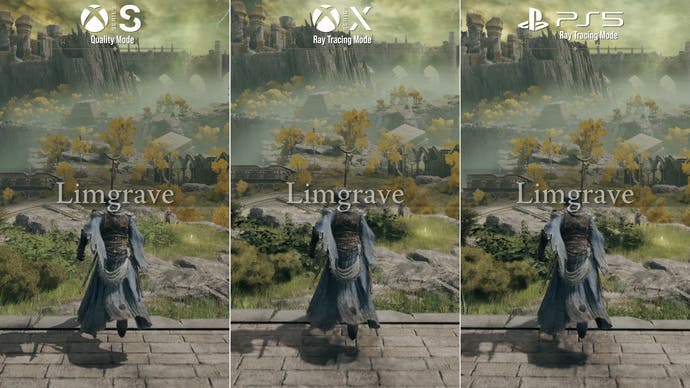
Transferring on, the second a part of the RT improve is the addition of ray-traced ambient occlusion (RTAO). In impact, shadows for confined areas such because the corners of dungeons, the roots of grass tufts and bushes at the moment are extra precisely simulated with ambient shade. This replaces the reasonably low-quality screen-space ambient occlusion (SSAO) used on console and PC as normal, which creates odd silhouette artefacts. The RT mode solves this difficulty and creates thicker, extra constant shading no matter whether or not it seems inside screen-space.
Once more, there are some limitations right here. For one, RTAO and RT shadows are lacking in cutscenes on console, such because the introduction to the Margit boss, however return for gameplay afterwards. Shadow pop-in can be extra noticeable with RT enabled. The boundaries of RTAO are completely different to SSAO, and Elden Ring seems to make use of a BVH construction that calculates RT shadows at completely different factors within the map. We seen shadows beneath barrels ‘swap on’ abruptly at a sure proximity to the participant, whereas they’re factored into the scene earlier utilizing common SSAO in high quality mode. So it is one thing to keep in mind, however Elden Ring does look higher general for having RT enabled.
It is value noting as properly that these outcomes apply equally to PS5 and Sequence X, with matching high quality RT shadows and RTAO, and matching decision targets of 2880×1620 (75 % of 4K). Pixel counts do present some variance right here indicative of dynamic decision scaling, at 1560p at some factors, however 1620p is the standard rely. In contrast, the standard modes with out RT enabled run at a full 4K, so you might be sacrificing some element to get RT.
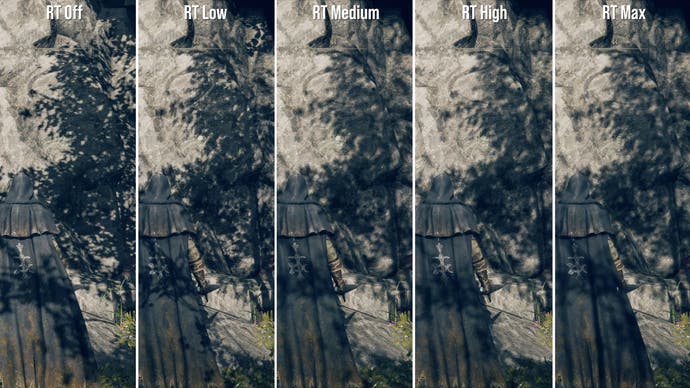
On PC, reasonably than a binary RT on/off we get 4 ranges of RT high quality as we talked about earlier. Even on low, RT shadows look higher than the non-RT shadows, whereas medium offers one other noticeable step up in high quality. Past this, the variations are a lot much less pronounced, with the max setting wanting similar to medium and excessive for shut topics, with solely distant shadows and AO actually benefitting from increased RT settings. The excessive setting appears essentially the most balanced possibility, because it permits each increased accuracy RT for sun-cast shadows and improved draw distance and not using a huge efficiency penalty. Consoles look to be utilizing the excessive or max setting, primarily based on side-by-side comparisons, with even the PC max setting exhibiting the identical half-rate or third-rate animations that we noticed on the Stormhill gate earlier.
So the RT improve is significant visually – however is it definitely worth the efficiency penalty? Trying first at PS5, it is debatable. In a single take a look at, we noticed frame-rate mode operating at 60fps, high quality mode at round 40-45fps and high quality + RT mode at simply 30fps. A 15-20fps penalty for enabling RT does not really feel worthwhile, particularly because it additionally comes with a decision downgrade.
The truth that the majority of play in RT mode runs at or simply above 30fps is way from splendid, because it’s under the PS5’s VRR window and does not really feel easy in any respect. The truth is, the sport typically dips under the 30fps line in RT mode, which signifies that not not even a 30fps cap would offer a constant expertise.
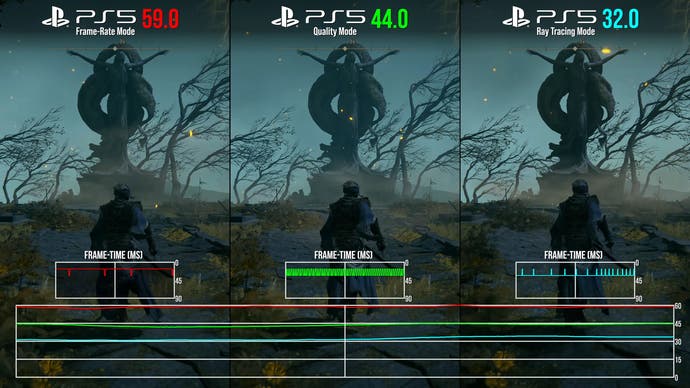
The result’s that the RT mode is hardly splendid, although truthfully it is the worth you’d anticipate to pay for further visible options layered on prime of an expertise that was already sub-60fps. The largest drawback is the existence of those sub-30fps drops, which genuinely have an effect on the sport’s playability.
Switching to Sequence X, it is a lot the identical – solely barely worse than PS5. The typical frame-rate on its ray tracing mode is as much as 5fps decrease on common, which signifies that Sequence X can be extra susceptible to sub-30fps drops. I’ve seen the most important drops on Sequence X relate to its dynamic settings and backbone, and a slight delay within the renderer maintaining with the motion. For instance, if we glance to get the sky we get 45fps at 1620p – however wanting downwards sharply, the decision does not dip quick sufficient to keep away from a visit under the 30fps line. Nonetheless, the turnout for Sequence X is not radically completely different to PS5 in any other case, and with a lot play hovering round 30fps, it is laborious to advocate.
PC efficiency in fact is determined by your {hardware}, with our testing carried out utilizing an entry-level to mid-range spec: an AMD Ryzen 5 3600 CPU, paired with 16GB of DDR4-3600 RAM and an Nvidia RTX 2070 GPU. We’re operating at settings equal to PS5 and Sequence X’s high quality mode as properly, choosing max the place consoles use a hybrid setting, and at a set 1800p decision given there is no DRS on PC.
With out RT, this configuration runs comfortably at 60fps a lot of the time, however the open space of Limgrave is more difficult, making it a superb take a look at run. We noticed a median of 33fps with RT set to excessive versus 51fps with it disabled. Or to place it one other method, that is a 35 % efficiency hit from excessive RT. The RT mode additionally introduces further hitches, with the frame-time spiking as much as 180ms at worst – hardly splendid.
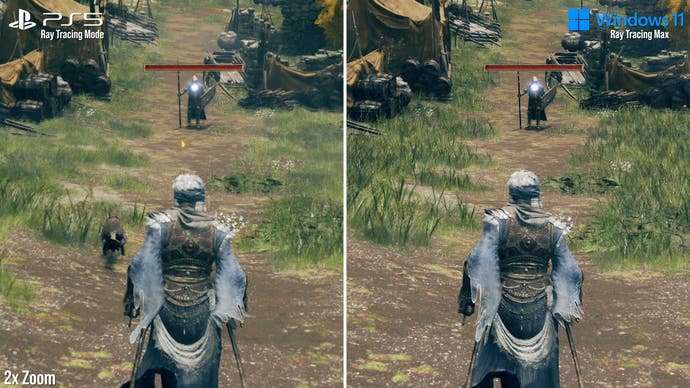
The underside line is that the PC launch of Elden Ring has larger priorities forward of ray tracing: efficiency continues to be capped at 60fps, ultrawide shows aren’t supported and there is no DLSS, FSR 2 or XeSS picture reconstruction to spice up efficiency and offset the price of RT.
To sum up then, the addition of RT is a welcome shock, an additive function that pays dividends when it comes to the presentation of shadows and ambient occlusion on PS5, Sequence X and PC. Nevertheless, it is laborious to see this because the function most Elden Ring followers wished, within the context of continuous sub-60fps efficiency on console; within the context of hitches and lacking options on PC. And given its efficiency penalty, we will not advocate truly enabling RT for a playthrough of the sport, though it may be good for taking screenshots.
Extra broadly, the choice to seemingly prioritise the addition of RT as a substitute of fixing the sport’s technical shortfalls is baffling. Given how nice the core sport is, and the way commercially profitable it has been, we are able to solely hope that it is a signal of extra sensible growth to return.