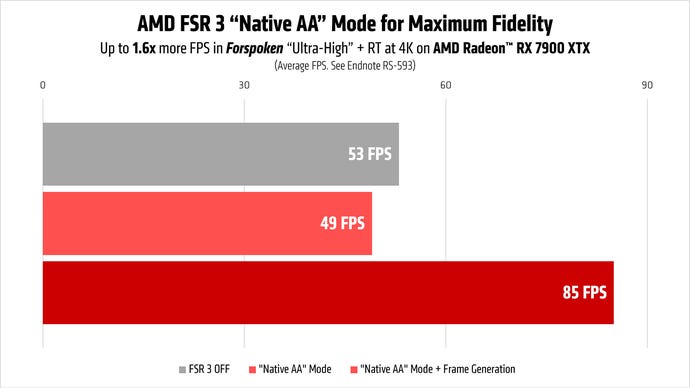
Apologies to Geoffey Ok and his GTA 6-loving stage invader, however for me, the torquiest head-turner of Gamescom 2023 was not a recreation however AMD FSR 3. The Radeon gang’s lengthy awaited reply to DLSS 3 lastly bought a correct reveal, showcasing how its body technology function – referred to as Fluid Movement Frames – might triple efficiency in supported video games. And, whereas it was revealed alongside two new GPUs – the Radeon RX 7800 XT and RX 7700 XT – AMD normal supervisor Scott Herkelman advised that FSR 3 will work “on any graphics card” as soon as it launches.
The difficulty of compatibility is extra sophisticated than that, although it’s straightforward to see the constructive influence of a mixed upscaler/body generator that’s way more extensively out there than DLSS 3. Nvidia’s model, in spite of everything, narrows down the GeForce RTX GPU requirement of DLSS upscaling to merely the most recent RTX 40 collection. The principle catch thus far appears to be that FSR 3’s potential advantages are presently snagged up in a web of technical jargon and interconnected Radeon-branded software program techniques.
So! Let’s see if we are able to’t do some untangling, Right here, in human-friendly phrases, is how FSR 3 works – and why it might change into fairly the massive deal for PC gaming efficiency.
What’s FSR 3?
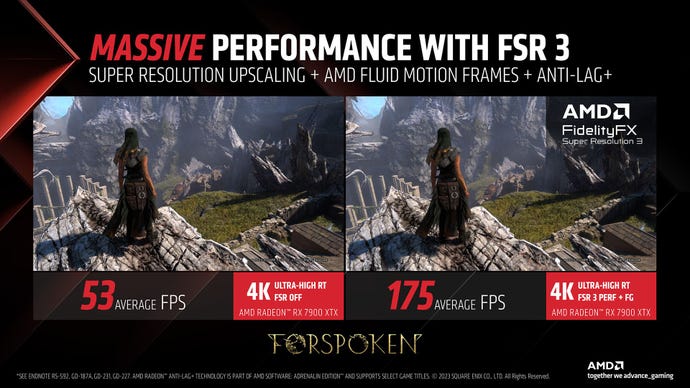
FSR 3, or FidelityFX Tremendous Decision 3, is primarily a GPU-based upscaler for video games. Like earlier variations, together with FSR 2 and FSR 2.1, it will possibly render a recreation at a decision decrease than that of your monitor, then immediately convert every rendered body to native decision in such a method that makes it seems to be prefer it was by no means lower-res to start with. Ideally, you’ll be able to barely inform the distinction (if in any respect), and the decrease pressure of rendering at a sub-native decision permits your video games to run at larger framerates. FSR, Nvidia DLSS and Intel XeSS are the massive three gaming upscalers in widespread use, and all three can produce spectacular outcomes.
FSR 3 provides one other function: body technology, generally also referred to as body interpolation. Whereas the GPU renders frames within the ordinary style, FSR 3 can analyse knowledge from earlier frames and use them to create model new ones: Fluid Movement Frames, as AMD name them. FSR 3 subsequently slots these in-between the rendered frames, growing framerates. This course of prices virtually nothing normally GPU energy, so you’ll be able to doubtlessly get large frames-per-second boosts with the one hitch being a little bit of added enter lag.
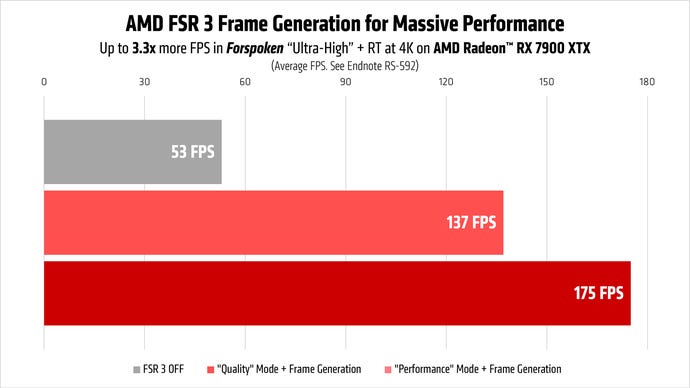
To place it one other method, FSR 3 does largely the identical factor as DLSS 3, which was the primary gaming upscaler so as to add body technology when it launched final 12 months. I’ll need to see FSR 3 in motion with my very own eyes earlier than declaring it a real step ahead, however contemplating how potent DLSS 3 has confirmed as a efficiency help, the idea is clearly sound.
What’s extra, FSR 3 might have a serious benefit in its lack of graphics card exclusivity. DLSS may be a better-looking upscaler than FSR, and its personal body technology approach advantages from AI/machine studying smarts that FSR 3 can’t make the most of. Even so, Fluid Movement Frames don’t should look excellent, simply shut sufficient to ‘actual’ rendered frames that your eyes gained’t be capable to inform the distinction. Extra importantly, as a result of FSR 3 doesn’t want the precise AI {hardware} of an RTX GPU, it will possibly run on AMD and Nvidia graphics playing cards alike, making body technology way more accessible.
Will FSR 3 actually work with any graphics card, although?
Right here’s the place issues get a bit difficult. Throughout the Gamescom reveal, Herkelman particularly stated that AMD “enabled FSR 3 not simply to work on Radeon graphics playing cards, to work on any graphics card.” Very cool, besides that additional studying means that whereas FSR 3 upscaling may be out there to any outdated GPU, FSR 3 body technology may want a more recent or extra highly effective card in spite of everything.
This AMD neighborhood put up lays out some FSR 3 system necessities of kinds, itemizing the Radeon RX 5700 and GeForce RTX 20 collection (and above) as supporting the total mixture of upscaling and body technology. Older fashions, together with the RX 590 and GTX 10 collection, are listed as supporting upscaling solely. A word provides that body technology efficiency will “rely upon the capabilities of your GPU,” and that “on older {hardware} chances are you’ll not have an optimum expertise and may even see little to no enchancment in efficiency.”
Supported and beneficial {hardware} for AMD FSR 3 with upscaling and body technology:
| AMD | Nvidia |
|---|---|
| Supported: AMD Radeon RX 5700 and above | Supported: Nvidia GeForce RTX 20 collection and above |
| Really helpful: AMD Radeon RX 6000 collection and above | Really helpful: Nvidia GeForce RTX 30 collection and above |
Supported and beneficial {hardware} for AMD FSR 3 with body technology solely:
| AMD | Nvidia |
|---|---|
| Supported: AMD Radeon RX 590 and above | Supported: Nvidia GeForce GTX 10 collection and above |
| Really helpful: AMD Radeon RX 5000 collection and above | Really helpful: Nvidia GeForce RTX 20 collection and above |
The straightforward model seems thus: you’ll be able to strive to allow Fluid Movement Frames on older GPUs, together with Nvidia’s, however it may not really assist a lot. The dearth of Intel GPUs in these lists can be curious, although given how a lot the “any graphics card” angle was burdened at Gamescom, I’m prepared to chalk that all the way down to AMD merely overlooking a a lot smaller competitor, reasonably than suggesting FSR 3 gained’t work in any respect. FSR 2 upscaling is usable simply nice on present Intel Arc playing cards.
Even with probably the most pessimistic interpretation of those {hardware} lists, thoughts, FSR’s body technology will undoubtedly get pleasure from a far wider vary of suitable GPUs than DLSS 3’s.
Every other drawbacks to pay attention to?
Simply as with DLSS 3, FSR 3’s body technology course of will add latency, particularly within the type of enter lag. I’ve by no means discovered this a really offputting downside with Nvidia’s tackle the tech, however should you do find yourself utilizing it with a Radeon GPU, you’d be sensible to have interaction its latency discount software to minimise any sluggishness. That’s Radeon Anti-Lag on RX 5000/6000 GPUs, and Radeon Anti-Lag+ on the RX 7000 collection.
AMD additionally solely advocate participating Fluid Movement Frames when you’ll be able to already get a minimum of 60fps with out it, by the way crushing my desires of FSR 3 being a magic go-faster button for the standard Steam Deck. This additionally sounds counterintuitive – certainly a PC that will get decrease framerates is probably the most in want of assist? – however it does make sense, when it comes to decreasing how tangible that added latency will be.
As DLSS 3 has already proven, generated frames produce a visible enhancement however don’t make the sport really feel smoother as effectively, as they’re basically being created exterior the system that’s additionally recording your mouse and keyboard inputs. Making certain a baseline stage of tactile management smoothness is subsequently nonetheless as essential as ever, particularly as it will possibly assist soak up the latency influence of body technology.

When is FSR 3 releasing, and which video games are suitable with it?
FSR 3 doesn’t have a concrete launch date but, although it will likely be up and operating in video games someday this autumn. First up can be a double invoice of magic shooters: Immortals of Aveum and Forspoken, each of which can get updates so as to add FSR 3 assist. Different confirmed video games to eith launch and get updates later embody Cyberpunk 2077 (together with its Phantom Liberty enlargement), House Marine II, and Like a Dragon: Infinite Wealth. Right here’s the total record of twelve that AMD confirmed at Gamescom:
- Avatar: Frontiers of Pandora
- Black Fable: Wukong
- Crimson Desert
- Cyberpunk 2077
- Forspoken
- Frostpunk 2
- Immortals of Aveum
- Like a Dragon: Infinite Wealth
- Starship Troopers Extermination
- Squad
- The Alters
- Warhammer 40,000: House Marine II
That’s clearly not loads, although each FSR and DLSS launched with tiny suitable libraries as effectively, and have since discovered their method into a whole bunch of video games apiece. AMD may even be taking one other cue from Nvidia by creating an FSR 3 plugin for Unreal Engine, which could make it simpler for sure builders to get it applied.
There’s additionally the truth that this record solely covers video games with absolutely baked-in FSR 3 assist. AMD additionally introduced HYPR-RX, a driver-level toolkit that’s set to increase the attain of AMD’s Fluid Movement Frames tech a lot, a lot wider.

What’s HYPR-RX, and the way is it associated to FSR 3?
HYPR-RX is a brand new a part of AMD’s Radeon drivers, bringing collectively three bits of driver-level, performance-boosting tech: AMD Radeon Increase, AMD Radeon Anti-Lag+, and AMD RSR (Radeon Tremendous Decision). These are variously helpful by themselves, as I’ve by no means seen Radeon Increase critically enhance framerates and RSR is basically an uglier various to FSR upscaling, however they do benefit from working in an enormous number of video games which are based mostly on DirectX 11 and 12.
HYPR-RX partly exists to deliver all of them below a single toggle, accessible by way of the AMD Software program: Adrenalin Version app. However from early 2024, it’ll additionally acquire the power to generate Fluid Movement Frames, making it doable to get body technology on the driver stage – no matter whether or not a recreation has assist for full-fat FSR 3. AMD have proven this in motion with Fluid Movement Frames giving an almighty framerate push to Lies of P, which you’ll word isn’t on the record of FSR 3-compatible video games.
If I’m sincere, I can’t see HYPR-RX’s Fluid Movement Frames trying as sharp as these created by true FSR 3, simply as RSR’s upscaling is inferior to FSR 2’s. It additionally has a big, DLSS-style downside in that it’s tied to Radeon Anti-Lag+, which occurs to be unique to Radeon RX 7000 GPUs. In different phrases, you will want a really particular graphics card, in contrast to with FSR 3. Nonetheless, this upcoming improve might have a sure area of interest use, serving to RX 7000 homeowners get an FPS enhance out of video games that don’t have any suitable upscalers built-in.
What about Native AA mode?
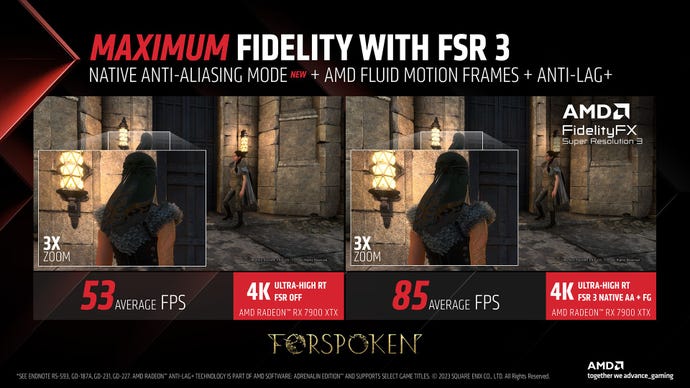
Ah! Right here’s one other nifty addition. Native AA mode is the FSR 3 model of Nvidia DLAA: it takes the upscaling software’s built-in anti-aliasing, and applies it a recreation with out the precise upscaling. This may be helpful particularly while you’re already getting good efficiency, however don’t fairly just like the look of the sport’s personal anti-aliasing. Properly, TAA is not for everybody.
Like FSR 3 as an entire, builders will nonetheless must manually implement Native AA, although because it’s additionally suitable with Fluid Movement Frames it could possibly be very effectively fitted to enjoying at 1080p. This decision is often too low for upscalers to provide a sufficiently sharp picture, however Native AA ought to help you get the efficiency good thing about FSR 3 body technology with out having to make that tradeoff to general high quality.