Maria Lvova-Belova, a Russian official wished by the Worldwide Prison Court docket for abducting Ukrainian youngsters, visits Minsk to debate the “safety of kids.”
Hungary’s overseas minister makes a second controversial go to to Minsk. Belarusian dictator invitations Hungarian Prime Minister Viktor Orban to go to Belarus.
A Belarusian official claims Minsk has each proper to “pave a hall” by way of Lithuania to transit its items – a press release Vilnius calls an “open menace to assault Lithuania.”
Ukrainian authorities observe the withdrawal of most Russian troops from Belarus.
The Purple Cross’ Belarusian department refuses to dismiss its head, regardless of the IFRC’s demand.
Belarusian authorities sentence three rock band members, whose songs voiced assist for anti-regime protests in 2020, to jail.
Subscribe to the E-newsletter
Belarus Weekly
Russian official wished for abduction of Ukrainian youngsters visits Minsk
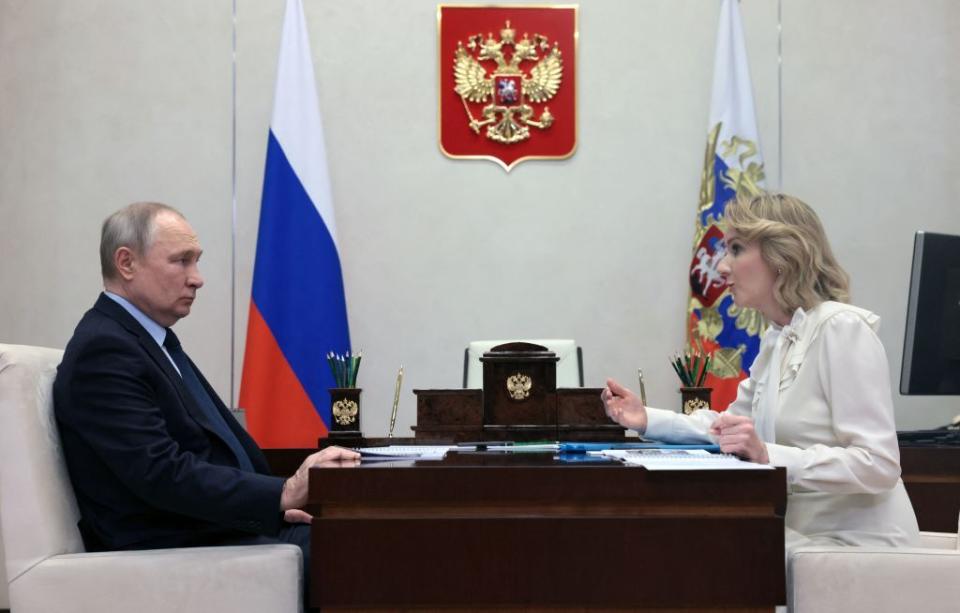
Russian Youngsters’s Rights Commissioner Maria Lvova-Belova, who is needed by the Worldwide Prison Court docket (ICC) for her position within the unlawful switch of Ukrainian youngsters to Russia, arrived in Minsk on Nov. 1.
In line with Russian state-controlled media, Lvova-Belova met with Russian Ambassador to Belarus Boris Gryzlov and mentioned problems with so-called “youngster safety” with the Basic Secretary of the Commonwealth of Unbiased States, Sergei Lebedev.
The ICC issued an arrest warrant for Russian President Vladimir Putin and Lvova-Belova for coordinating the unlawful switch of kids from Russian-occupied elements of Ukraine because the onset of Russia’s full-scale battle.
The illegal switch and deportation of individuals constitutes a battle crime underneath worldwide legislation.
In line with official estimates, Russia has kidnapped over 20,000 youngsters from Russian-occupied elements of Ukraine, though the quantity is probably going a lot larger.
Throughout his assembly with Lvova-Belova, Gryzlov famous that 2,250 youngsters from Russian-occupied elements of Ukraine, which he inaccurately known as “liberated territories,” have arrived in Belarus.
The European Parliament known as on the ICC in September to problem the same arrest warrant for Belarusian dictator Alexander Lukashenko’s complicity within the crime, as Belarusian authorities have admitted to internet hosting youngsters taken from Ukraine.
“If we communicate the language of information, then no nation or group on this planet has carried out as a lot to make sure the security and well-being of Ukrainian youngsters as Russia and Belarus,” Lvova-Belova claimed, including that she’s going to proceed to steer the transfers.
“As for the West’s accusations, all the things is distorted: the evacuation of kids turns into ‘deportation,’ guardianship turns into ‘compelled adoption.’ That is being carried out with the goal of demonizing the picture of Russia,” she claimed.
Lukashenko invitations Orban to Belarus, Orban to contemplate
Belarusian dictator Alexander Lukashenko prolonged an invite to Hungarian Prime Minister Viktor Orban to go to Belarus because the nation sinks into deeper isolation amid its involvement in Russia’s battle towards Ukraine.
Lukashenko conveyed the message to Orban by way of Hungarian Overseas Minister Peter Szijjarto, who made his second go to to Minsk final week because the onset of Russia’s full-scale battle.
Throughout Szijjarto’s go to, Lukashenko expressed eager to “talk about critical issues with Orban,” including that he’s open to “dialogue with European international locations.”
Orban’s press chief stated the prime minister would think about the invitation after coming back from a European Union summit in Brussels.
Szijjarto attended a convention titled “Eurasian Safety: Actuality and Prospects in a Reworking World.”
In line with Minsk, the convention was geared toward a “frank and inclusive dialogue on the prospects for Eurasian safety within the context of the prevailing world order disaster, continual army and political contradictions between key international gamers, and the virtually full lack of communication between them.”
The Belarusian Overseas Ministry stated the occasion additionally touched on financial integration and a “unified Eurasian safety structure,” the “threats and alternatives” posed by nuclear weapons, and “strategic stability.”
“Peace and coherence are what’s going to permit Europe to be robust and protected once more,” Szijjarto stated in the course of the convention, in keeping with Belarusian state-controlled media. “European peoples, together with Hungarians, have already paid a heavy value for the battle in Ukraine, even supposing we’re not chargeable for it.”
“I consider that it is rather vital to maintain channels of communication open,” he added, noting that “international safety is now in its worst form because the finish of the Chilly Conflict.”
Belarusian democratic opposition chief Sviatlana Tsikhanouskaya criticized Szijjarto’s go to, saying “there can’t be any deal-making with a dictator concerned in battle crimes, (the) kidnapping of kids, and terror towards his personal individuals.”
Szijjarto visited Minsk again in February, making him the primary senior official of a EU member state to go to Belarus within the aftermath of the regime’s brutal crackdown on civil society in 2020.
His go to sparked controversy, with critics saying the transfer went towards the EU’s strategy to Belarus and Russia’s battle.
The Hungarian authorities underneath Orban has been criticized for its strategy to Russia and Belarus amid the battle towards Ukraine. Orban has issued a number of statements criticizing Western help to Ukraine, sanctions towards Russia, and international locations’ European and NATO trajectory.
Belarusian official threatens to ‘pave hall’ by way of Lithuania to transit items
Belarus’ First Deputy State Secretary of the Belarusian Safety Council Pavel Muraveiko claimed Belarus has each proper to “pave a hall” by way of Lithuania to transit items.
Lithuania halted the transit of Belarusian items by way of its territory in February 2022 in a transfer geared toward punishing Lukashenko’s regime for its crackdown on Belarusian civil society.
Lithuania additionally suspended the transit of sure Belarusian items to and from Kaliningrad Oblast, a Russian exclave nestled between Poland and Lithuania, in June 2022 to adjust to EU-imposed sanctions.
On the time, Lukashenko stated Lithuania’s determination to adjust to EU sanctions “resembles a declaration of battle.”
“Lithuania really forbade us to maneuver our items throughout the border,” Muraveiko stated on Oct. 30. “From the attitude of banal logic, now we have each purpose to chop by way of a vitally vital hall for us by power of arms.”
Lithuania’s Overseas Ministry summoned Belarus’ interim cost d’affaires, Yaroslav Khmyl, “expressing a powerful protest over the threatening remarks” made by Muraveiko.
The ministry famous that Muraveiko’s statements might be interpreted as an “open menace to assault Lithuania and are solely unacceptable,” including that it expects Minsk to problem an official clarification.
Lithuania and Poland have each expressed issues about provocations by Russia and Belarus, particularly close to the Suwalki Hole.
Learn additionally: Riots in North Caucasus underscore rampant antisemitism in Russia
Ukrainian authorities: Russia probably withdrew all troops from Belarus
Russia seems to have withdrawn and never changed its troops stationed in Belarus, the spokesperson for Ukraine’s State Border Guard Service, Andrii Demchenko, stated on Oct. 31.
In line with Demchenko, there are nonetheless some Russian army personnel in Belarus, however they’re for probably the most half those that service Russian tools within the nation.
He added that the Border Guard Service is actively monitoring the border with Belarus and that the state of affairs is “totally underneath management,” noting that there is no such thing as a proof that personnel or tools are being moved towards Ukraine.
Demchenko added that underneath 1,000 of the 8,000-some Wagner Group mercenaries despatched to Belarus this previous summer time to coach the nation’s army stay.
The variety of Russian army personnel stationed in Belarus at one level reached a excessive of 10-11,000 again in 2022, and dropped sharply all through 2023. Ukraine’s Border Guard Service recorded an estimated 1,000 Russian troops in June, for instance.
Ukrainian Lieutenant Basic Serhii Naiev famous in late August that Russia’s floor forces had been totally withdrawn from Belarus.
Russia’s preliminary assault on the onset of its full-scale invasion of Ukraine in 2022 was launched from Belarus. Russia has since used Belarusian territory as a launching pad for assaults on Ukraine and to coach Russian troops earlier than sending them to the entrance line.
Belarusian Purple Cross chief to stay regardless of name for dismissal
The pinnacle of the Purple Cross’ Belarusian department, Dzmitryi Shautsou, has not stepped down from his submit regardless of the Worldwide Federation of Purple Cross and Purple Crescent Societies’ (IFRC) request that he accomplish that.
The IFRC demanded that Shautsou be dismissed in early October after he bragged about taking youngsters from Russian-occupied elements of Ukraine to Belarus and was proven in Ukraine’s Donbas area carrying army clothes adorned with the letter “Z,” which is a Russian pro-war image.
The IFRC’s board gave the Belarusian department till Nov. 30 to dismiss Shautsou, noting that it will in any other case droop the department and urge all stakeholders to cease cooperation with it.
Nevertheless, the Belarusian department voted again in September to maintain Shautsou in workplace and, in keeping with Russian state-controlled media TASS, Shautsou has continued in his position.
The Belarusian department reportedly has no intention of dismissing Shautsou and denounces the IFRC’s demand that it accomplish that, claiming it’s appearing in accordance with the Belarusian Purple Cross’ constitution.
The Belarusian Purple Cross additionally claimed Shautsou has no plans to go to Donbas once more, and that his earlier journey to the Russian-occupied elements of Ukraine’s Donetsk and Luhansk oblasts was “brought on by the necessity to defend the reputations” of Belarus and the IFRC from “accusations of abducting… youngsters who beforehand participated in Belarusian Purple Cross-provided restoration help in Belarus.”
In line with the assertion, Shautsou is “personally satisfied that these youngsters returned dwelling safely,” and that the Belarusian Purple Cross is simply working inside Belarusian territory.
Belarus fingers standard rock musicians prolonged jail sentences
A Homiel court docket gave the three members of Tor Band, a preferred Belarusian rock group whose songs voiced assist for anti-regime protests in 2020, prolonged jail sentences on Oct. 31.
Authorities sentenced Yauhen Burlo, Andrei Yaremchyk, and Dzmitryi Halavach to eight, seven and a half, and 9 years in jail, respectively.
The musicians had been accused of “insulting” Lukashenko, “discrediting the nation,” establishing a so-called “extremist group,” and “inciting hatred.”
Burlo, Yaremchyk, and Halavach had been arrested in October 2022 and placed on trial on Oct. 14 of this 12 months. Again in January, Belarusian authorities labeled the band “extremist,” a time period utilized by Belarusian authorities to discredit those that oppose Lukashenko’s dictatorship.
The band, which hails from Rahachou, a small city in southeastern Belarus, rose to fame in 2020 after it launched its standard single, “We’re not a individuals,” which criticized Lukashenko’s makes an attempt to quell the protests responding to the fraudulent election. (You may test it out right here).
“All of them cried in the course of the verdict,” an unnamed supply instructed Radio Free Europe/Radio Liberty’s Belarusian service. “Certainly one of their family misplaced consciousness in the course of the verdict’s announcement. Yauhen Burlo was on crutches, he might hardly transfer. He didn’t even get up in the course of the announcement of the decision.”
Learn additionally: How Russia’s liberal tech corporations turned the muse of Putin’s battle effort
Evening of the Murdered Poets
The Highlight section offers readers with the historic context of up to date occasions in Belarus.
Late on Oct. 29, Belarusians commemorate the Evening of the Murdered Poets, also called the Black Evening, marking the height of the Soviet Nice Terror of 1937.
100 thirty-two representatives of Belarusian intelligentsia, together with writers and poets, scientists, and public figures, had been shot lifeless in Minsk and buried within the outskirts of town.
In 1937, Soviet tyrant Joseph Stalin signed the listing of “individuals topic to trial by the Navy Collegium of the Supreme Court docket of the USSR.” The Belarusian part of the listing included 103 people in a trumped-up case of so-called “united anti-Soviet underground resistance.”
Native authorities added extra people to the listing, ending up with 132 names, which included Ales Dudar, the primary to translate Pushkin’s poem “Eugene Onegin” into Belarusian, poets Yuli Taubin, Todar Kliashtorny, author and the previous prime minister of short-lived Belarus Individuals’s Republic Vatslau Lastouski, the chairman of the primary Soviet Belarusian authorities Tsishka Hartny, and plenty of others.
In whole, in 1937-38, round 500 Belarusian cultural figures had been both despatched to camps or murdered on the spot by the Soviet regime.
Researcher Leanid Mariakou means that Soviet Secret companies killed or despatched to camps greater than 90% of Belarusian writers.
The place of their burial was revealed solely in 1988 after Zianon Pazniak, now a well known opposition determine within the nation, revealed the article “Kurapaty – the Highway of Demise.”
Primarily based on analysis and small-scale excavations, Pazniak proved that Kurapaty, the forested space close to Minsk, was the positioning of mass executions between 1937 and 1941. Tens of 1000’s of persons are stated to be buried there.
After Lukashenko took energy, he cracked down on these commemorating the victims of the Soviet regime.
To commemorate the victims of Stalin’s terror, activists positioned dozens of crosses in Kuropaty. A few of them had been demolished by authorities. A street was additionally commissioned to run throughout the positioning.
Visiting the memorial now would possibly lead to an arrest. Eighty-six years after the Nice Terror, the brand new technology of Belarus’ intelligentsia is jailed or exiled, whereas books concerning the occasions of 1937 are banned by the state.
We’ve been working onerous to convey you impartial, locally-sourced information from Ukraine. Contemplate supporting the Kyiv Unbiased.