
On the night time of December 2, 1943, German bombers attacked the southern Italian port of Bari. Serving as an important hub for the Allied troops throughout World Struggle II, the harbor was crowded with ships loaded with ammunition and provides. As explosions lit up the sky, seventeen ships sank, together with the US Liberty ship, John Harvey. The ship’s cargo of bombs blew up, spilling oil into the water and dispersing smoke into the air.
Lots of of sailors coated in oil escaped, however after a couple of hours, the sailors started exhibiting uncommon signs. Burns and blisters appeared on their skins, and eye irritation and labored respiratory set in. Inside a day, their well being quickly deteriorated, and a few sailors died. The docs couldn’t decide the reason for their deaths or advocate a therapy.

On December 2, 1943, German bombers launched an air assault on the Allied port in Bari, Italy, inflicting ammunition loaded on the ships to blow up.
Credit score: Wikimedia Commons
The USA Military dispatched Lieutenant Colonel Stewart Francis Alexander, a younger medical physician from New Jersey, to analyze the sailors’ mysterious deaths. “When he arrived at Bari, he appreciated a garlic-like scent of mustard gasoline, so he instantly suspected,” stated Michael Nevins, a retired New Jersey heart specialist and internist who was Alexander’s pal and colleague. “The credit score goes to his nostril.”
The John Harvey had been carrying a secret load of two,000 mustard gasoline bombs. Mustard gasoline gained its worldwide infamy as a chemical warfare agent throughout World Struggle I. By the point World Struggle I resulted in 1918, mustard gasoline had intoxicated an estimated 1.2 million troopers and contributed to 80% of the chemical casualties, making it the deadliest struggle gasoline of its time (1). The outbreak of World Struggle II in 1939 intensified nations’ efforts to develop, manufacture, and stockpile chemical weapons. Not lengthy after, mustard gasoline made its reappearance in Bari.
Alexander’s subsequent investigation marked an sudden flip within the story of mustard gasoline. Scientists in numerous laboratories and medical establishments world wide began to acknowledge the potential for harnessing mustard gasoline’ poisonous properties and remodeled it right into a weapon to fight a special enemy: most cancers. Their efforts finally transformed this lethal chemical agent into chemotherapy.
From pores and skin to blood
Working with mustard gasoline had by no means been protected. In 1860, when Frederick Guthrie from the College of Edinburgh first synthesized mustard gasoline by reacting ethylene and sulfur dichloride, he skilled irritation on his personal pores and skin (2). That very same 12 months, Albert Niemann on the College of Göttingen repeated the response and suffered pores and skin reddening and blistering (3). Later, Viktor Meyer on the College of Göttingen achieved the primary dependable synthesis of pure mustard gasoline by modifying the formulation, leading to a extra poisonous product (4). In 1913, Hans Thacher Clarke on the College of Berlin additional developed Meyer’s formulation and launched a extra environment friendly methodology for synthesizing mustard gasoline (5). Because of unintended publicity, Clarke was hospitalized, however finally, his methodology was employed for large-scale mustard gasoline manufacturing throughout warfare.

Chemists Albert Niemann (left) and Viktor Meyer (proper) pioneered the synthesis and large-scale manufacturing of mustard gasoline in the course of the 1800s.
Credit score: Wikimedia Commons
Harmful chemical compounds by no means intimidated Alexander. “Again in highschool, he had a chemistry lab within the basement of the home,” stated Nevins. In 1941, two years earlier than the tragic incident in Bari, Alexander had simply begun his medical apply in New Jersey when he acquired a summons from the US Military. The USA Chemical Warfare Service (CWS), which was established throughout World Struggle I for producing poison gasoline and defensive tools, sought out medical specialists throughout the nation to bolster the military’s preparedness for potential chemical gasoline assaults.
The CWS introduced Alexander into the Medical Analysis Laboratory on the Edgewood Arsenal facility in Maryland to conduct analysis on chemical warfare brokers and develop prevention and therapy strategies. At Edgewood, Alexander consulted specialists, evaluated the toxicity of various brokers on animals, and discovered to determine totally different toxins, together with chlorine, phosgene, and mustard gasoline by their odors. Quickly, he turned a chemical weapons professional.
In early 1942, the CWS assigned Alexander to analyze a brand new chemical agent known as nitrogen mustard, a risky liquid with a chemical construction much like mustard gasoline that had little to no odor. Utilizing rabbits, Alexander arrange experiments on numerous organs and methods, together with the pores and skin, eyes, respiratory tract, and blood. Like mustard gasoline, nitrogen mustard triggered burns on the pores and skin and totally different organs. Nevertheless, the agent’s results on the blood astonished Alexander.
For a typical burn harm, the immune system normally ramps up white blood cell manufacturing to battle off infections. In Alexander’s nitrogen mustard experiments, the other occurred. Inside a number of days after publicity to nitrogen mustard, the rabbits’ white blood cell numbers drastically dropped till they utterly disappeared. The rabbits’ lymph nodes melted away, and their bone marrow turned depleted of blood cells (6).
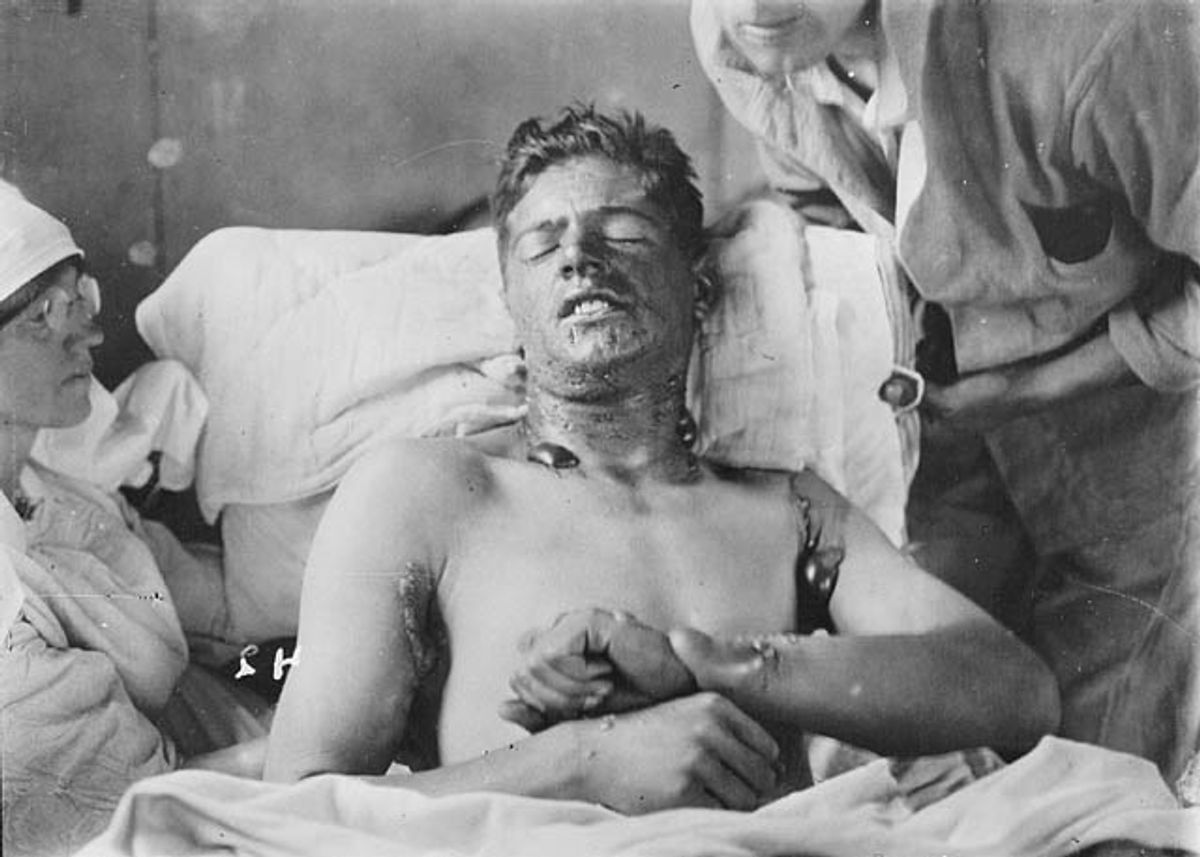
A Canadian soldier suffered burns attributable to mustard gasoline throughout World Struggle I.
Credit score: Wikimedia Commons
After acquiring the identical outcomes from different laboratory animals comparable to rats and mice, Alexander believed that nitrogen mustard disrupted the physique’s blood manufacturing by attacking white blood cells. He started to surprise if nitrogen mustard would have the identical results on people. If it did, it is likely to be developed to deal with leukemia, a situation marked by uncontrolled development of white blood cells. Alexander documented his findings and speculation in a report printed internally inside the CWS in June 1942, however his report went unappreciated (6).
A 12 months later, within the aftermath of the Bari assault, Alexander examined the sailors and confirmed his suspicions of mustard gasoline publicity. As he went by way of the docs’ medical case sheets and pathology studies, one recurring remark stood out: the white blood cell counts of severely injured sufferers took a pointy downward activate the third or fourth day after the incident. These outcomes agreed with Alexander’s animal research at Edgewood, supporting Alexander’s curiosity in turning a poison right into a drug to deal with leukemia and lymphoma.
In December 1943, after conducting intensive blood and bone marrow exams, Alexander submitted a report on his investigation of the Bari catastrophe (6). His report was instantly categorized by the federal government to keep away from triggering a chemical struggle. However the US army medical advisers, together with Cornelius Rhoads, chief of the CWS’s Medical Division, fastidiously appraised Alexander’s work, lastly paying attention to nitrogen mustard’s therapeutic potential. “Rhoads was very excited concerning the prospects of how this could possibly be became one thing helpful in peacetime,” stated Nevins.
The substance X undertaking
Whereas Alexander served within the CWS investigating chemical weapons at Edgewood, one other analysis program on struggle gasoline was secretly occurring 200 miles away. In 1942 at Yale College of Medication, the varsity’s Dean, Milton Winternitz, signed a authorities contract with the Workplace of Analysis and Growth.
Winternitz had beforehand studied struggle gasoline poisonings throughout World Struggle I and acknowledged the pressing want to analyze new chemical warfare brokers and develop antidotes. He assigned two younger pharmacologists, Alfred Gilman and Louis Goodman, to review the toxicity of the brand new chemical agent nitrogen mustard, which was coded as substance X.
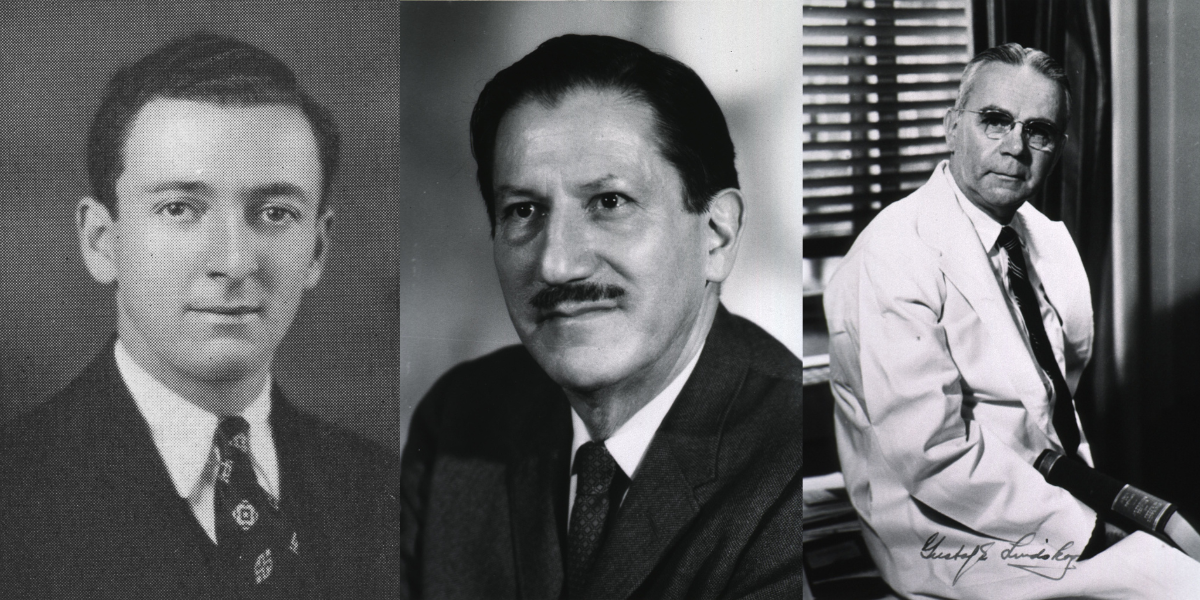
Alfred Gilman (left), Louis Goodman (center), and Gustaf Lindskog (proper) carried out the primary human trial of nitrogen mustard to deal with lymphosarcoma.
Credit score: Yale College Library and Nationwide Library of Medication
Gilman and Goodman started their testing by exposing rabbits to substance X. Like Alexander, they noticed the fast disappearance of lymphocytes and granulocytes within the rabbits. “The systemic results of the nitrogen mustards had been way more fascinating than the blisters they produced on the pores and skin,” Gilman recalled in an article printed in The American Journal of Surgical procedure in 1963 (7). They puzzled if this agent might destroy quick rising most cancers cells earlier than it attacked the host.
The pair consulted Thomas Dougherty, an anatomist at Yale College of Medication, who supplied them with a mouse transplanted with superior lymphosarcoma. When Gilman and Goodman handled this mouse with nitrogen mustard, its tumor softened and shrunk after simply two administrations of the chemical. With extra doses, the tumor disappeared. A lot to everybody’s shock, the mouse survived a remarkably very long time (7).
Gilman and Goodman eagerly wished to maneuver ahead with a human trial and offered their animal experimentation information to Gustaf Lindskog, the chair of surgical procedure at Yale College of Medication. Intrigued by the encouraging outcomes, Lindskog agreed to oversee the trial. The group quickly discovered a possible candidate, a 47-year-old affected person with most cancers at Yale New Haven Hospital.
The affected person had terminal lymphosarcoma and had undergone all doable therapy choices with none success. Since all hope for restoration appeared misplaced, Lindskog approached the affected person, recognized to historical past as JD, with a daring experiment that may save his life.
“They’d an in depth dialog with him about what they had been enterprise, and that this was an experimental choice, and that no one knew what was going to occur,” stated Dieter Lindskog, grandson of Gustaf Lindskog and orthopedic surgeon at Yale College of Medication.
JD determined to take the chance. “They’d no concept, clue, or something resembling steering on dosing,” stated Lindskog. Their finest trace was their toxicity research on rabbits, which urged a dosage of 0.1 mg per kilogram of nitrogen mustard. Just a few days later, JD turned the primary recipient of intravenous chemotherapy for most cancers.
“The affected person’s tumor had a fabulous response,” stated Lindskog. Inside 48 hours, the tumor started to melt, and the affected person felt higher. By the tenth day, when the sequence of injections ended, his tumor was not palpable, and all most cancers signs had disappeared.
By day 49, the affected person’s tumor made a vigorous return and have become immune to nitrogen mustard. Regardless of receiving two extra programs of therapy, his situation failed to enhance. He finally handed away on day 96 (8). Because of the confidentiality surrounding chemical warfare brokers, the medical information of this trial had been censored and had been later misplaced to time, leaving many particulars undisclosed.
Fashionable chemotherapy
In June 1943, the nitrogen mustard analysis group at Yale College dispersed, however the medical trials testing nitrogen mustard’s therapeutic potential continued. Goodman collaborated with researchers in a number of establishments across the nation to deal with extra sufferers.
Gilman, Goodman, and their collaborators launched particulars about their research in 1946 after World Struggle II had ended and the secrecy related to the struggle gasoline program had been lifted. On this landmark report, they documented 67 nitrogen mustard medical trials, together with JD’s case, for treating Hodgkin’s illness, lymphosarcoma, and numerous forms of leukemia. The report demonstrated vital tumor regression in most sufferers, with medical remissions lasting from weeks to months (8).

Cornelius Rhoads labored for the US Military creating chemical weapons. After the struggle, he led analysis on utilizing mustard gasoline for most cancers therapy.
Credit score: Nationwide Library of Medication
Rhoads, who beforehand appreciated Alexander’s Bari report, was additional inspired by Gilman and Goodman’s medical trials. He began vigorously looking for funding for creating chemotherapy after the struggle. In 1948, Rhoads turned the director of the Memorial Sloan-Kettering Most cancers Heart, which spearheaded the event of a number of essential chemotherapy medicine, together with mustard derivatives and different antitumor compounds.
In 1949, the US Meals and Drug Administration permitted mechlorethamine, a nitrogen mustard compound, as the primary chemotherapy drug for hematologic malignancies (9). Round that point, scientists began to know how the agent works within the physique. Two chemists, Philip Lawley and Peter Brookes on the Royal Most cancers Hospital, unraveled the molecular mechanisms behind the agent’s cancer-killing properties.
Mustard gasoline and nitrogen mustard each belong to a category of chemical compounds referred to as alkylating brokers. Within the cell, these brokers bear a sequence of reactions to kind a extremely reactive intermediate, which covalently modifies DNA in a response known as DNA alkylation. DNA alkylation disrupts cell replication and causes mobile injury, which makes alkylating brokers significantly efficient at destroying quickly dividing cells comparable to white blood cells and most cancers cells (10,11).
This info stimulated researchers to synthesize and take a look at extra alkylating compounds to battle most cancers. A number of new chemotherapy medicine emerged in the course of the Fifties, comparable to chlorambucil and busulfan, alkylating brokers that deal with leukemia by stopping white blood cells from rising and spreading (9). Over the next many years, scientists launched greater than 100 totally different chemotherapy medicine into medical apply to deal with quite a few most cancers sorts, together with leukemia, lymphoma, myeloma, sarcoma, and breast, lung, and ovarian cancers.
Chemotherapy created a complete new specialty, apply, and discipline of medication. At this level, there’ll completely be leaps, breakthroughs, and big paradigm modifications.
– Dieter Lindskog, Yale College of Medication
Chemotherapy has led to exceptional remission charges and extended survival for quite a few sufferers. Its success in killing fast-dividing most cancers cells laid the muse for the event of more practical therapeutic approaches, comparable to focused therapies and immunotherapies. “Chemotherapy created a complete new specialty, apply, and discipline of medication,” stated Lindskog. “At this level, there’ll completely be leaps, breakthroughs, and big paradigm modifications.”
Setting the report straight
As researchers proceed to make leaps and bounds in chemotherapy growth, others are nonetheless uncovering hidden particulars about its early days. Though JD’s case was printed in Gilman’s report in 1946, the main points of the case had been minimal, and JD’s medical information disappeared.
In 2010, John Fenn, a surgeon and Lindskog’s colleague at Yale College of Medication, discovered concerning the saga of the primary chemotherapy trial Gilman, Goodman, and Lindskog carried out throughout World Struggle II. Fascinated by it, Fenn teamed up together with his colleague, Robert Udelsmam, a former medical professor of surgical procedure at Yale College of Medication and present surgeon on the Miami Most cancers Institute, to unearth JD’s medical information.
“We contacted a senior colleague in pathology,” Udelsmam recalled. “The pathology division had an impartial database for the archive of each affected person ever seen at Yale primarily based on their prognosis, the affected person’s identify, their medical report, and the 12 months.”
Missing key info comparable to identify, date of beginning, and medical report quantity, Fenn and Udelsmam had solely the affected person’s initials, which matched with quite a few pathology studies from the early Nineteen Forties. After months of looking, they recognized a promising pathology chart of a affected person with lymphosarcoma and a medical report quantity, however that didn’t make them JD’s medical information. Suspecting errors within the report quantity, they started rearranging the quantity sequences and inserting extra numbers. After a number of failed searches, they finally tracked down JD’s full medical information. “It was thrilling on the time,” stated Udelsman. “I keep in mind when John put the chart down on my palms. I had the unique chart proper in entrance of me. I could not imagine we discovered it!”
If that is actually the primary type of intravenous chemotherapy with an antineoplastic agent on the planet, it’s big! It needs to be in each textbook.
– Robert Udelsmam, Miami Most cancers Institute
The uncovered information shed new gentle on JD’s private background and medical course. As a Polish immigrant, JD moved to the US at age 18 and misplaced his household in the course of the struggle. “He did not converse English and labored in a ball bearing manufacturing facility. He had no partner, no kids,” stated Udelsman. “It gave the impression of a really lonely, remoted life.”
The misplaced recordsdata additionally added context to JD’s earlier therapies, providing insights into why he might need chosen to take part within the experimental trial. He was recognized with lymphosarcoma in 1940 and underwent a number of radiation therapies at Yale New Haven Hospital in 1941. Sadly, his tumor turned progressively unresponsive, inflicting respiratory misery, dysphagia, and weight reduction. Physicians famous in JD’s medical information that his outlook was “totally hopeless” (12).
“They had been watching his tumor develop every day,” famous Udelsman. “In tough conditions, docs are extra inclined to make use of doubtlessly poisonous brokers and poisonous doses of an agent to attempt to have a therapeutic profit.”
Though the therapy didn’t finally save JD’s life, Udelsman was not shocked. “It is not uncommon in chemotherapy that sufferers develop clones of lymphocytes which are refractory to therapy. Just a few cells stay which are surviving, they usually change into increasingly more refractory to the drug,” he defined. “These days, we use mixture chemotherapeutic therapies for this very cause.”
In 2011, Fenn and Udelsmam printed their investigation of JD’s case within the Journal of the American Faculty of Surgeons, lastly setting JD’s report straight six many years after the case and bringing gentle to the difficult historical past of chemotherapy therapy (12). “If that is actually the primary type of intravenous chemotherapy with an antineoplastic agent on the planet, it’s big!” stated Udelsman. “It needs to be in each textbook.”
References
- Darchini-Maragheh, E. & Balali-Temper, M. Delayed Issues and Lengthy-term Administration of Sulfur Mustard Poisoning: Current Advances by Iranian Researchers (Half I of II). Iran J Med Sci 43, 103–124 (2018).
- Guthrie, F. XIII.—On some derivatives from the olefines. Q J Chem Soc 12, 109–126 (1860).
- Niemann, A. Ueber die Einwirkung des braunen Chlorschwefels auf Elaylgas. Justus Liebigs Annalen der Chemie 113, 288–292 (1860).
- Meyer, V. Ueber Thiodiglykolverbindungen. Berichte der deutschen chemischen Gesellschaft 19, 3259–3266 (1886).
- Duchovic, R. J. & Vilensky, J. A. Mustard Fuel: Its Pre-World Struggle I Historical past. J Chem Educ 84, 944 (2007).
- The Nice Secret | Jennet Conant | W. W. Norton & Firm.
- Gilman, A. The preliminary medical trial of nitrogen mustard. The American Journal of Surgical procedure 105, 574–578 (1963).
- Goodman, L. S. & Wintrobe, M. M. Nitrogen mustard remedy; use of methyl-bis (beta-chloroethyl) amine hydrochloride and tris (beta-chloroethyl) amine hydrochloride for Hodgkin’s illness, lymphosarcoma, leukemia and sure allied and miscellaneous issues. J Am Med Assoc 132, 126–132 (1946).
- Puyo, S., Montaudon, D. & Pourquier, P. From previous alkylating brokers to new minor groove binders. Essential Evaluations in Oncology/Hematology 89, 43–61 (2014).
- Lawley, P. D. & Brookes, P. Interstrand cross-linking of DNA by difunctional alkylating brokers. Journal of Molecular Biology 25, 143–160 (1967).
- Brookes, P. & Lawley, P. D. The response of mustard gasoline with nucleic acids in vitro and in vivo. Biochemical Journal 77, 478–484 (1960).
- Fenn, J. E. & Udelsman, R. First Use of Intravenous Chemotherapy Most cancers Remedy: Rectifying the File. Journal of the American Faculty of Surgeons 212, 413 (2011).