

As a part of finding out lengthy COVID, graduate researcher Bradley Wade Hamilton separates out microclots from blood platelets in an answer.
Anil Oz/NPR
conceal caption
toggle caption
Anil Oz/NPR

As a part of finding out lengthy COVID, graduate researcher Bradley Wade Hamilton separates out microclots from blood platelets in an answer.
Anil Oz/NPR
Take heed to Brief Wave on Spotify, Apple Podcasts and Google Podcasts.
The federal COVID-19 public well being emergency ended final week, however thousands and thousands within the U.S. — and throughout the globe — are nonetheless coping with the repercussions of the COVID-19 pandemic within the type of lengthy COVID.
Estimates present that greater than 65 million worldwide have the situation, which encompasses a variety of signs which can be worsened or seem after preliminary SARS-CoV-2 an infection. However three years after the primary folks with persistent signs have been documented, there isn’t a biomarker for the illness — no take a look at or swab that may diagnose somebody with lengthy COVID.
A bunch of researchers is trying to change that.
From lungs to blood
Early within the pandemic, most considered COVID-19 as a respiratory illness. Resia Pretorius, a professor of physiological sciences at Stellenbosch College in South Africa was seeing one thing else. After spending years finding out blood clotting patterns in different ailments, like diabetes, lupus and arthritis, she was seeing hints of comparable, blood-related signs in COVID sufferers.
“It was fairly clear from pattern one which we’re extreme clotting pathology,” she says.
At the moment, Pretorius and her collaborators are seeing what the blood of lengthy COVID sufferers can inform them concerning the illness nevertheless it began as they tried to know what COVID was doing to the blood throughout an acute an infection.

Fluorescent picture of a microclot from a protracted COVID affected person proven at 40x magnification.
Mount Sinai Well being System
conceal caption
toggle caption
Mount Sinai Well being System
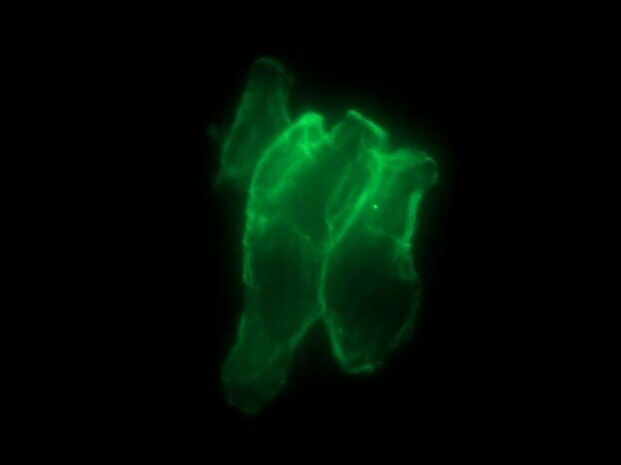
Fluorescent picture of a microclot from a protracted COVID affected person proven at 40x magnification.
Mount Sinai Well being System
“The spike protein has the potential to vary your soluble clotting protein to insoluble little microclots and that is the place every part begins,” Pretorius says. “So when you could have acute COVID you’ll have activated platelets, you’ll have vascular harm in endothelial harm and you’ll have a microclot presence in some people.”
In some folks, after round two weeks, the physique will start to interrupt down these insoluble microclots and they’re going to return to regular. However for others, these microclots cling round and so they can harm blood vessels in addition to block blood circulation to many organs — which might assist clarify lengthy COVID’s wide-ranging signs.
“You get widespread and systemic-induced … irritation of your blood vessels—the within of your blood vessels. If it is systemic, it means it is in each organ. It is in each a part of your physique,” Pretorius says. “It signifies that oxygen switch can’t occur because it ought to, between your blood and your organ techniques as a result of the car, the blood, is broken these clots [are] in there. However extra importantly, your vasculature is compromised.”
A potential biomarker
And not using a constant strategy to take a look at for and determine folks with lengthy COVID, it is harder for researchers to review the illness and infrequently tougher for sufferers to get the care they want.
Pretorius says that many lengthy COVID sufferers see medical doctors who do not imagine the total extent of their signs, even when they take a look at sufferers’ blood. Which signifies that when sufferers “go to clinicians, they do the usual pathology workup, blood workup and so they say ‘Sorry, you do not have something, there’s nothing incorrect with you as a result of all of your blood assessments are regular,'” she says. “The explanation for that’s they are not trying on the proper place.”

The aim of Pretorius and her collaborators is to assist design a greater take a look at that physicians can use to determine these with excessive ranges of microclots. A type of collaborators is David Putrino, the director of rehabilitation innovation for Mount Sinai Well being System. He hopes that the take a look at they’re creating can go additional for sufferers with different put up viral diseases too.
“Typically we’re informed, effectively, ‘Every part’s testing regular. We examined all the usual panels, every part’s come again regular.’ I believe one of many issues that we have to say time and again is that, you already know, the blood panels, the usual blood panels that we take a look at for, they actually solely seize a really slim scope of our physiology,” he says.
The work he and Pretorius are doing exhibits that the microclots they’re seeing, along with hyperactivated platelets, “can actually mess along with your physique’s potential to perform.” The subsequent step is to discover a strategy to make a mainstream take a look at for it.
All the lengthy COVID sufferers Putrino has examined have had microclots and hyperactivated platelets, which is one thing he would not generally see in individuals who have by no means had COVID or who’ve totally recovered. It is this excessive stage of microclots in lengthy COVID sufferers that Putrino thinks is likely to be the biomarker. One of many questions that is still is, in the event that they proceed to see this sample on a much bigger scale, is focusing on and eliminating these microclots an efficient remedy?
Roy Silverstein, a hematologist on the Medical School of Wisconsin who is not concerned with this work, says he has two foremost questions going ahead:
“If [microclots] current within the blood in sufferers with lengthy COVID and never within the blood of sufferers with out lengthy COVID, might they subsequently be used as a marker for varied remedies to see if, initially, to outline the extent of plausibility that the affected person has lengthy COVID? After which to make use of as a marker in remedy research?”

There are different ailments which can be marked by modifications to the blood’s clotting patterns within the capillaries, particularly Thrombotic Thrombocytopenic Purpura and Hemolytic Uremic Syndrome. The clots brought on by lengthy COVID are manufactured from distinctive proteins. “They are not the everyday micro clots that we see with these different illness … they’re made up virtually totally of irregular sort of fibrin, which is the protein and blood that kinds the blood clot and creates these uncommon buildings which can be referred to as amyloid,” he says.
A singular supply of funding
Pretorius and her lab have been working across the clock with the hope of serving to lengthy COVID sufferers sooner fairly than later. The primary group of people that have lengthy COVID at the moment are reaching the three 12 months mark with the illness.
“That is a very, actually very long time to be struggling with this sickness, which, in lots of circumstances has a high quality of life that’s simply so, so low, like unfathomably low to most individuals — undoubtedly unfathomably low to me, you already know, not having recognized about post-viral sickness beforehand,” says Hannah Davis, a co-founder and lead researcher of the Affected person Led Analysis Collaborative, who has had lengthy COVID since March 2020.

Due to that urgency, Pretorius took an uncommon step — crowdfunding donations to purchase a circulation cytometer, which makes use of lasers to research particular person cells. Initially, she was utilizing customary fluorescent microscopes, that are frequent in analysis labs however not hospitals. To be able to iron out a technique that might work for medical settings, she began utilizing the way more frequent circulation cytometer.
She says the pace with which she received enough cash factors to the necessity for this analysis in a second the place conventional grants could also be too sluggish. “If it wasn’t for the determined nature of the illness, I believe we’d not have been in a position to crowdfund in such a short while.”
Whereas Pretorius and her colleagues are making progress, Davis says that it should not have come to this.
“I get to be a part of this, this take a look at growth course of that each one of our affected person advocacy and affected person relationships and issues like which have led to — this second and … sort of a really concrete influence on our life,” she says. “It should not must be like this, proper? Like, it ought to be the case that thousands and thousands of {dollars} are designated for locating a biomarker or figuring out and making a take a look at or each.”
Take heed to Brief Wave on Spotify, Apple Podcasts and Google Podcasts.
Questions? Thread of scientific analysis you are loving? Electronic mail us at shortwave@npr.org — we would love to listen to about it!
This episode was produced by Margaret Cirino and Berly McCoy, edited by Gabriel Spitzer and managing producer Rebecca Ramirez. It was fact-checked by Emily Kwong, Rebecca and Berly. The audio engineer was Robert Rodriguez.