
“We won’t be happy till justice rolls down like waters, and righteousness like a mighty stream.”
The Rev. Martin Luther King Jr. delivered these phrases throughout his iconic “I Have a Dream” speech on the March on Washington — which occurred almost 60 years in the past, on Aug. 28, 1963.
Within the 55 years since his demise, King is commonly quoted and revered — an icon, himself.
However within the new e-book “King: A Life,” creator Jonathan Eig attracts King as “a person, not a saint, not an emblem” — delivering way more nuance than historical past has allowed.
Eig joined “Chicago Tonight: Black Voices” to debate the e-book and King’s life and legacy.
WTTW Information: No small quantity of phrases have been written about Martin Luther King Jr., however your e-book is totally different. What have been you attempting to perform with this one?
Jonathan Eig: I needed to write down a extra intimate portrait, but in addition one which restored his true radical nature. One of many issues that’s occurred within the 60 years for the reason that March on Washington and within the 55 years since his demise is that we’ve turned him right into a nationwide vacation and a monument, issues that he deserves. However within the course of, we’ve watered down his message and we’ve forgotten that he was human. We’ve forgotten that he struggled, that he had doubts, that he suffered, that he skilled moments of uncertainty. And I needed to write down a e-book that made him really feel extra relatable.
The e-book contains particulars from an unpublished memoir written by his father, who was massively influential in Martin Luther King Jr.’s life. What did you find out about what sort of father he was, and the way that might affect MLK as an grownup?
Eig: Daddy King was a troublesome man. He walked off the farm. He was born right into a sharecropping household in Stockbridge, Georgia. On the age of 12 or 13, walked off the farm along with his sneakers tied collectively and slung over his shoulder so he wouldn’t put on them out, strolling barefoot towards Atlanta the place he principally reinvented himself. He taught himself to learn. He grew to become a pastor and took over Ebenezer Baptist Church. However he additionally made it doable for Martin Luther King Jr. to be who he was — actually renamed him. They have been each born Michael King. Renames himself, renames his son and creates an setting the place his son can truly dream of carrying out the sorts of modifications {that a} earlier era actually may solely dream about.
I discovered rather a lot — he plagiarized a bit in his early writings, had a critical relationship with a White girl earlier than Coretta, he was bold and charismatic. However he was additionally proof against elevating the ladies of the motion, he had some extramarital affairs and perhaps a number of, and lots of relationships earlier than marriage. How did you navigate the totally different photographs of Martin Luther King Jr.?
Eig: He lived solely 39 years, however in that 39 years he packed in a lot. He was a really difficult man. He was any individual who actually didn’t like battle. He’s our biggest protest chief, and he doesn’t like battle. And I believe a few of that comes from his relationship along with his father. However you see it with Coretta, too, as a result of Coretta was an activist earlier than they even met. Coretta had extra credentials as an activist than he did after they met.
And but as you identified, he was resistant when it got here to letting her get entangled within the motion. He needed her to remain dwelling and lift the children. So I simply tried to essentially lean into all of that complexity and never attempt to simplify the person. Simply let the reader determine for themselves how they really feel about his weaknesses, his flaws and the way that figures into his greatness as a result of it’s all tied collectively.
It’s additionally the primary biography to make use of these audiotapes of Coretta King — her recounting every thing from their first date to getting ready Dr. King’s funeral. What sort of affect was she in his life?
Eig: I really like Coretta. She’s such an interesting individual. And I believe that the explanation King is drawn to her is as a result of she’s so sturdy and he or she’s so outspoken in terms of activism. When King wins the Nobel Peace Prize, Coretta says we now have a larger duty now — not you, we — have a larger duty to talk out on points past civil rights, to speak about human rights, to speak about revenue inequality and poverty, battle. And it’s Coretta actually typically main the way in which. And I believe that she deserves much more credit score than she usually will get.
You write about King’s time protesting slums and segregated housing in Chicago and his work with native leaders — organizing with Timuel Black, who was at first uncertain of him understanding Chicago’s difficult politics. He stated at one level “This can be a horrible factor. I’ve been in lots of demonstrations all throughout the South, and I can say I’ve by no means seen — even in Mississippi and Alabama — as hostile and as hate-filled as I’ve seen in Chicago.” What did King be taught from his time in Chicago?
Eig: Effectively, he was advised by a lot of his closest associates to not come right here, that he thought they thought that he didn’t know what he was entering into and that Northern racism was extra pernicious in some ways as a result of it was higher hidden than the racism that he encountered within the South.
And I believe when King left right here, he was deeply annoyed, however he was decided that he was not going to surrender. He felt like Mayor (Richard J.) Daley was not dealing squarely with him, that Daley agreed to truly meet various King’s necessary calls for. After which as quickly as King left city, these calls for have been ignored, and that’s one thing we dwell with in the present day. That the legacy of that failure to embrace King’s reforms haunts us to at the present time.
How did King’s visits to Chicago, after which staying in North Lawndale in a while, replicate a shifting motion, and his place in it?
Eig: King was very profitable by most measures within the South. He helped get passage of the Voting Rights and the Civil Rights Act, however he was not happy with that. He stated that Northern segregation, Northern racism was simply as unhealthy and wanted to be addressed. And when he got here right here, he misplaced a number of his help and a number of the White Northern liberals who despatched cash, despatched checks to help his work, instantly misplaced curiosity in what he was doing. And the identical factor occurred when he spoke out concerning the Vietnam Conflict. We overlook that within the final three or 4 years of his life, King was actually fading when it comes to his recognition, and other people didn’t actually imagine in him. Even the March on Washington, we rejoice this weekend, 70% of Individuals have been in opposition to it.
Eig: I would like folks to do not forget that King was a person that he had moments of doubt. And when you consider him that method, he turns into larger as a hero. And it additionally implies that we are able to aspire to emulate him as a result of we don’t need to be excellent to struggle for what we imagine in.
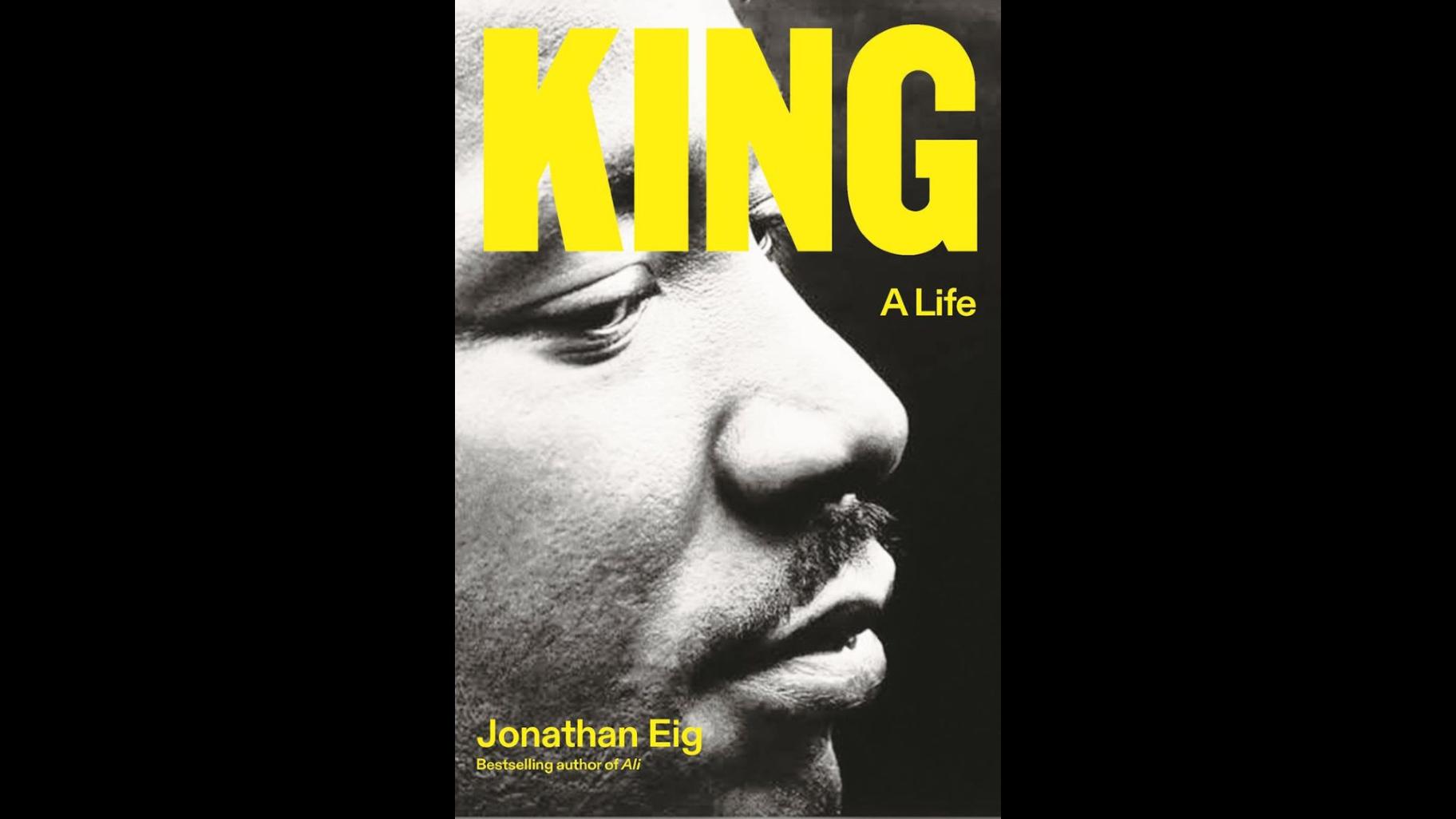 “King: A Life” by Jonathan Eig.
1
The Kings of Stockbridge
TAKE THIS BUCKET of milk to the neighbors, Delia King advised her son Michael someday.
Delia and her husband, Jim King, lived with their rising brood of kids in a tiny picket sharecroppers’ shack in Stockbridge, Georgia, about twenty miles southeast of Atlanta. The shack and the land round it belonged to a white man. The white man stored a lot of the cash from the crops, however it was the King household, one era faraway from slavery, that cleared the soil stone by stone, planted and picked the cotton, and went hungry when the scorching solar rendered the earth no extra fertile than a rutted street. But when Delia heard that her neighbor had a sick cow that wouldn’t give milk, she acted with out hesitation.
“She was a really religious Christian,” recalled Michael, who would go on to alter his identify to Martin Luther King Sr. “I keep in mind, as a small boy, my mom was a girl who shared what she had with others,” he stated in a newly found set of audiotaped interviews he made for an unpublished autobiography.
Michael was about twelve years outdated when his mom despatched him on his mission that vivid summer season day round 1910. As he carried his bucket, he paused in entrance of a sawmill the place he watched burly males and oxen at work, hauling timber. A voice snapped him to consideration. It was the white mill proprietor: “Say, boy, run get a bucket of water for my males from down on the stream.”
Apologizing, Michael advised the mill proprietor he was on an errand. He wanted to go. The mill proprietor grabbed Michael by his shirt and kicked over his bucket of milk. As Michael bent to select up the bucket, the white man’s boot linked with the boy’s ear. He tumbled. He tried to rise, however a fist smashed his face. Blood poured from his mouth. All the things went hazy.
Michael bought up, ran dwelling, and noticed his mom within the yard, washing garments in an iron tub set over a hearth. Delia scanned her son’s blood-crusted face and torn shirt.
“Who did this to you, Michael?” she requested, voice low and tight.
The boy didn’t reply.
“Michael!” Delia screamed. “Who did this?”
Delia marched to the mill, squeezing her son’s wrist as she tugged him alongside. She discovered the proprietor.
“Did you do that to my little one?” She locked eyes with the person.
“Girl! You misplaced your thoughts? Get the hell outta right here earlier than I—”
Delia screamed: “Did you do that to my little one?”
“Yeah…”
She lowered her shoulder and rammed the mill proprietor in his chest, knocking him into the aspect of a shed. She compelled him to the bottom and hammered at his face with palms and arms hardened by a lifetime of guide labor. When one of many mill employees tried to drag her away, Delia punched him, too. The others backed off.
“You may kill me! However should you put a hand on a toddler of mine, you’ll reply.”
Delia balled her fists, prepared for extra, however the mill proprietor needed none of it.
Again dwelling, Delia cleaned her son’s face. She warned him to not inform his father what had occurred. A Black girl would possibly get away with beating a white man, however a Black man would probably pay along with his life.
Quickly, although, Jim King heard concerning the mill proprietor’s assault on his son. As Delia had feared, Jim grabbed a rifle and went to the mill bent on revenge. The proprietor wasn’t there. That night time, a mob of white males on horseback rode to the Kings’ shack. Jim King knew the legislation provided no safety, so he did the one factor he may consider to avoid wasting himself and his household: he ran. He took off into the woods and stayed away by the summer season and into the autumn. Delia grew to become sick. The cotton crop suffered, and the greens bought picked too late. The household struggled to outlive the winter.
Months later, Michael heard from a good friend that the mill proprietor was now not offended. Issues may return to regular, the good friend stated. Jim King got here dwelling, however regular was not an possibility. “I’m gonna blow considered one of these crackers’ heads off,” he advised his son. Jim drank closely and argued forcefully with Delia. When he left the home, he went alone, and took his rifle. He tried to shoot one thing his household may eat, however he was usually too drunk to see a rabbit, a lot much less hit one.
“I simply puzzled what was regular for us,” Michael recalled, “and the way lengthy we may count on it to final.”
* * *
Michael King’s dad and mom have been born within the so-called Reconstruction years instantly following the Civil Conflict. Women and men not too long ago launched from slavery bought land, began church buildings, and constructed communities. They voted, too, electing greater than two thousand Black public officers, together with a governor in Louisiana, ten Black members of the U.S. Home of Representatives, and two U.S. senators. The historian Eric Foner described Reconstruction as “a radical experiment in interracial democracy,” throughout which previously enslaved laborers grew to become free laborers.
However the experiment failed. As W. E. B. Du Bois wrote, “The slave went free; stood a short second within the solar; then moved again once more towards slavery.”
The white backlash to Black folks’s features was instant—and harsh.
The U.S. authorities permitted white elected officers within the South to handle the so-called Negro drawback as they preferred. Racial animosity metastasized. A system of land rental, often called sharecropping, compelled Black farmers right into a relationship with white landowners that was deeply exploitative. Manufacturing facility homeowners and financiers within the North went alongside, for essentially the most half, silenced by the earnings generated by low cost labor. White officers within the South concluded that Black folks weren’t solely inferior, and subsequently unfit to be handled as equal residents, but in addition a menace to their bodily security. Southern lawmakers handed codes to determine methods of peonage not far faraway from slavery. By the beginning of the 20th century, each state within the South had legal guidelines designed to divide the races and subordinate Black folks. The segregation guidelines—generally often called Jim Crow legal guidelines—mandated separation of the races: in faculties, trains, theaters, church buildings, accommodations, hospitals, barbershops, restrooms, orphanages, prisons, funeral houses, cemeteries, and elsewhere. Jim Crow legal guidelines prohibited Black and white folks from enjoying checkers, dominos, and card video games collectively in their very own houses. Marriage between races was forbidden, too. For a lot of within the white group, the best concern of all was miscegenation, which might blur the road that they had labored so laborious to create and implement. For others, the best concern was a reordering of energy.
Supporters seen the Jim Crow legal guidelines as a system of controls, like dams and dikes, designed to protect the pure order as they perceived it. In 1896, the U.S. Supreme Court docket gave authorized sanction to segregation in Plessy v. Ferguson, creating an ordinary of “separate however equal” that was something however equal.
Atlanta grew to become the unofficial capital of the booming, divided South. It was in Atlanta, in 1895, that the Black educator Booker T. Washington proposed his well-known compromise, saying Black folks would not less than for the upcoming future settle for separation of the races if the white group, in return, took duty for bettering the talents and social circumstances of Black folks. However Washington’s critics feared that such a compromise would depart Black folks completely subservient. Georgia, as W. E. B. Du Bois wrote in 1903, grew to become “the centre of the Negro drawback,—the centre of these 9 million males who’re America’s darkish heritage from slavery and the slave-trade.”
Jim King—born the 12 months earlier than the abolition of chattel slavery—personified the crushing frustrations of Black life within the South. He by no means discovered to learn or write. He by no means voted. He by no means owned property. As a substitute, he lived in a perpetual state of debt to the white males for whom he farmed. He grew lean, edgy, and offended. America hadn’t given Jim King a lot, after which, little by little, it took away what little he had managed to build up, leaving frustration, travail, and rage. That’s how his son Michael described it. The American dream, constructed on guarantees written into the nation’s founding paperwork, misplaced all which means. Jim King drank till he had “a glance of very quiet however very critical fireplace in his eyes,” wrote his son, till he now not cared, “not about residing, not about ache, not about his anger or the rest.”
Delia, ten years youthful than her husband, held the household collectively. Born Delia Linsey in Ellenwood, Georgia, she, too, had grown up on a white-owned farm. Her father, Jim Lengthy, had been utilized in slavery to sire kids, to construct up the proprietor’s provide of enslaved laborers and enhance the proprietor’s return on funding in human property. Enslaved ladies have been the victims of those compelled sexual encounters. Delia’s mom, Jane Linsey, born in 1853, gave delivery to her first little one on the age of sixteen and went on to have 4 extra, with out marrying. By 1880, the federal census reported that Jane was twenty-seven, the mom of 5, single, not widowed or divorced, with no occupation aside from “holding dwelling.” Jim Lengthy seems on the following web page of the census, residing close by on the age of thirty-six, married to a girl named Francis, with ten extra kids.
Delia Linsey married Jim King in Henry County on August 20, 1895. On the wedding license, Delia’s maiden identify was spelled Lindsey. 5 years later, the Kings have been residing in Ellenwood, the place Jim labored as a day laborer and Delia took care of their daughter Woodie and their son Michael. One other son, Lucius, died sooner or later throughout infancy. Along with farming, Jim King labored part-time at a rock quarry till an accident within the quarry took considered one of his fingers and made additional work there inconceivable. By 1910, the Kings have been farming cotton in Stockbridge and elevating seven kids.
Federal census studies present that Delia King didn’t know the right way to learn or write in 1900 or 1910. However by 1920, at age forty-five, she had discovered, probably by studying the Bible. When she wasn’t giving delivery, feeding kids, cooking for her household, stitching, washing, planting greens, or choosing cotton, Delia cleaned and ironed garments for white households. When it rained, the roof leaked. When ice-cold wind blew by the cracks within the flimsy partitions, the household crowded across the fire, Michael recalled, “whereas our backs shivered.” They’d no working water and no indoor bathroom. “However Mama was at peace with herself,” Michael wrote, “due to her abiding religion.” It doesn’t matter what misfortune befell her, Delia King would by no means “shut her eyes so tight in sorrow or rage that she didn’t see God’s hand reaching out to her.”
Each Sunday, Delia and the youngsters walked to church, carrying their sneakers in order to not put on them out. They alternated between Methodist and Baptist church buildings. Jim King didn’t attend both one. “He didn’t care something about church,” Michael recalled. “He wouldn’t go to church … My daddy would work all week and on the finish of the week he would get drunk after which scrap with my mom … I bought to the place I hated Saturdays and Sundays for what my father was going to do and the way he was going to behave up.” However so long as Delia and the youngsters have been in church, they have been protected from Jim King’s anger.
Black Baptists outnumbered white Baptists in Georgia. Black tradition and Black political activism rose from the pews and pulpits of the Black church. For a lot of, faith provided launch from the ache of peculiar life. Black Baptist preachers ceaselessly imparted the novel message that all folks have been free and equal below God’s legal guidelines, that the foundations and laws handed down by white males have been mistaken, that the racial hierarchies invented by males to justify slavery have been false and craven, that the savagery of the Ku Klux Klan and the segregation legal guidelines of the South have been abominations within the eyes of God, and that God would by no means love one group of individuals greater than one other primarily based on the colour of their pores and skin. Prayers and hymns eased Delia King’s struggling. They provided hope that her kids and grandchildren would possibly dwell to see a greater day. Religion in God additionally helped create a way of group. Hog-killing time, for instance, introduced a festive sense of group and a residing reminder of the spirit of Jesus’s love. As Michael King would recall years later, those that owned animals large enough to slaughter shared meat with these in want, realizing they’d be repaid in variety someday. “That sort of sharing was to me Christianity in motion,” he stated.
Martin Luther King Jr., Delia’s grandson, would usually comment on the function Christianity performed within the lives of the enslaved and indentured. The land they farmed was not their very own. The crops they planted and sowed weren’t their very own. Their our bodies weren’t solely their very own. However their souls, he stated, would by no means belong to a plantation proprietor, a landlord, a hooded Klansman, a jail warden, a sheriff, a senator, or anyone else; their souls would all the time be free.
“So many issues stood there to discourage them,” Martin Luther King Jr. stated, “however the outdated preacher would provide you with his damaged language. He would look out to them and stated, ‘Mates, you ain’t no nigger. You ain’t no slave, however you God’s chillun.’”
They weren’t educated, King stated, “however they knew God.” They knew that the God they worshipped wouldn’t punish a few of his kids and exalt others. “And, so,” he continued, “though they knew that some days they needed to exit into the sphere of their naked toes, that didn’t cease them. And so they may sing of their damaged language:
I bought sneakers, you bought sneakers,
All of God’s chillun bought sneakers.
After I get to heaven gonna placed on my sneakers
And simply stroll throughout God’s heaven.”
* * *
A lot of the King household’s historical past can’t be traced again earlier than the Civil Conflict. Homeowners prevented the enslaved from studying to learn and write. Births and deaths usually went unrecorded. Tax collectors and census takers handled Black folks as property, their names not value noting. Within the first census after the Civil Conflict, taken in 1870, Jim King seems to be recorded as a five-year-old named James Branham of Eatonton, Georgia, in Putnam County. Jim’s age and the ages of his dad and mom—listed as Nathan and Malinda Branham—match the ages of King’s ancestors, suggesting maybe that the household selected to drop the Branham identify, which was a vestige of enslavement, and turn out to be Kings in freedom.
Tax information present that Jim and Delia King labored on a farm owned by a white man named William B. Martin, on land in Stockbridge partially occupied in the present day by a Walmart Supercenter.
Reprinted by permission of Macmillan Publishers. Excerpted from King: A Life by Jonathan Eig. Copyright 2023 Jonathan Eig. All rights reserved.