
For years, scientists have identified that the anti-aging hormone klotho, infusions of younger blood, and train every enhance mind perform in older mice. However they didn’t know why.
Now, two UC San Francisco analysis groups and a group from the College of Queensland (Australia) have recognized platelet issue 4 (PF4) – a small protein launched by blood platelets – as a standard denominator behind all three.
Platelets are blood cells that usually launch PF4 to alert the immune system and clot blood at wounds. The researchers discovered that PF4 additionally rejuvenates the outdated mind and boosts the younger mind, doubtlessly opening the door to new therapies that purpose to revive mind perform, if not faucet right into a fountain of youth.
“Younger blood, klotho, and train can in some way inform your mind, “Hey, enhance your perform,” mentioned Saul Villeda, PhD, affiliate director of the UCSF Bakar Growing older Analysis Institute and the senior writer on the Nature paper. “With PF4, we’re beginning to perceive the vocabulary behind this rejuvenation.”
Particulars of the breakthrough seem in a trio of papers in Nature, Nature Growing older and Nature Communications revealed August 16, 2023. Villeda led the research on younger blood revealed in Nature. Dena Dubal, MD, PhD, UCSF professor of neurology and David A. Coulter Endowed Chair in Growing older and Neurodegenerative Illness, led the research on klotho revealed in Nature Growing older. Tara Walker, PhD, senior analysis affiliate in neuroscience on the College of Queensland, led the research on train revealed in Nature Communications.
They dedicated to releasing their findings on the similar time to make the case for PF4 from three totally different angles.
“After we realized we had independently and serendipitously discovered the identical factor, our jaws dropped,” Dubal mentioned. “The truth that three separate interventions converged on PF4 really highlights the validity and reproducibility of this biology.”
Can a 70-year-old mind perform as if it’s 40?
In 2014, Villeda discovered that blood plasma, consisting of blood minus purple blood cells, from younger mice restored mind perform in outdated animals. His group then discovered that younger plasma contained rather more PF4 than outdated plasma.
Furthermore, simply injecting PF4 into outdated animals was about as restorative as younger plasma. It calmed down the aged immune system within the physique and the mind. Previous animals handled with PF4 carried out higher on quite a lot of reminiscence and studying duties.
“PF4 really causes the immune system to look youthful, it’s lowering all of those energetic pro-aging immune elements, resulting in a mind with much less irritation, extra plasticity and ultimately extra cognition,” Villeda mentioned. “We’re taking 22-month-old mice, equal to a human of their 70s, and PF4 is bringing them again to perform near their late 30s, early 40s.”
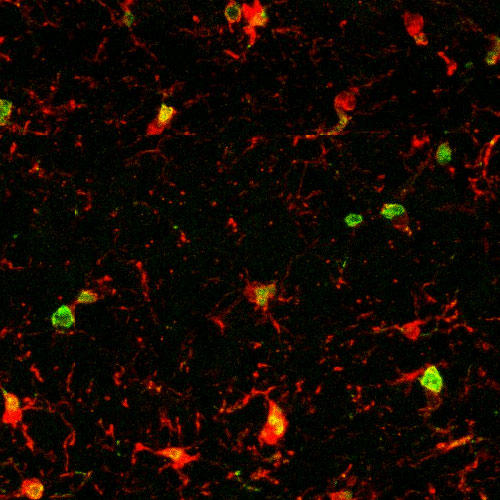
This microscopic picture exhibits microglia, immune cells within the mind, in purple. The inexperienced and yellow areas level to age-related irritation in an outdated mouse.
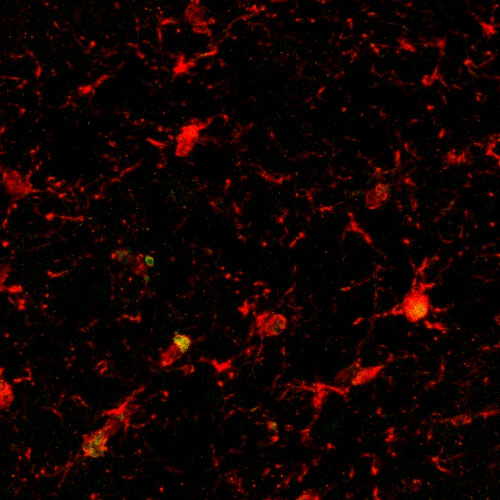
On this picture, an outdated mouse that was handled with PF4 has much less mind irritation. Credit score: Adam B. Schroer
Even younger brains get a lift
A decade in the past, Dubal, a member of the UCSF Weill Institute of Neurosciences, confirmed that the hormone klotho enhances mind perform in younger and outdated animals and likewise makes the mind extra proof against age-related degeneration. However klotho, injected into the physique, by no means reached the mind. So, how? Dubal’s group discovered that one connection was PF4, launched by platelets after an injection of klotho.
PF4 had a dramatic impact on the hippocampus, the place reminiscences are shaped within the mind. Specifically, PF4 enhanced the formation of recent neural connections on the molecular stage. It additionally gave each young and old animals a mind increase in behavioral assessments, suggesting that “there’s room to go even in younger brains to enhance cognitive perform,” in line with Dubal.
Different latest findings from Dubal have bolstered the prospects for utilizing klotho therapeutically. Klotho’s advantages depend upon platelets that launch PF4 and different molecules, which may every have their very own advantages throughout growing older.
“Ideally, we’ll have a number of pictures on objective for one in every of our largest biomedical issues, cognitive dysfunction, with the fewest uncomfortable side effects and essentially the most profit,” Dubal mentioned.
Train improves mind well being because of PF4
Train can hold the thoughts sharp for many years. In 2019, Walker and her lab discovered that platelets launched PF4 into the bloodstream following train. When she examined PF4 by itself, like Dubal and Villeda, it improved cognition in outdated animals.
“For lots of people with well being circumstances, mobility points or superior in age, train isn’t doable, so pharmacological intervention is a crucial space of analysis,” Walker mentioned. “We are able to now goal platelets to advertise neurogenesis, improve cognition and counteract age-related cognitive decline.”
Co-authors: Further UCSF authors on the Nature paper are Adam B. Schroer, PhD, Patrick B. Ventura, PhD, MS, Juliana Sucharov, Rhea Misra, M. Ok. Kirsten Chui, Gregor Bieri, PhD, Alana M. Horowitz, PhD, Lucas Ok. Smith, Katriel Encabo, MPH, Imelda Tenggara, June M. Chan, ScD, and Anthony Luke, MD, MPH. Further UCSF authors on the Nature Growing older paper are Cana Park, PhD, Shweta Gupta, PhD, Arturo J. Moreno, Francesca Marino, Dan Wang, MD, MS, Saul Villeda, PhD. Further UCSF authors on the Nature Communications paper are Adam B. Schroer, PhD, Gregor Bieri, PhD, Saul Villeda, PhD. For all authors, see the papers.
Funding and Disclosures: The analysis was supported, partly, by the Nationwide Institutes of Well being (Nature: AG064823, AG081038, AG077816, and AG067740; Nature Growing older: NS092918, AG068325; Nature Communications: R01AG077816), in addition to by philanthropy. For all funding sources and writer disclosures, see the papers.