
Whereas the PC launch of Horizon Forbidden West: Full Version has successfully made my PS5 possession pointless, I can’t keep mad at it. In addition to being a luxurious, endlessly satisfying sci-fi romp with one of many prettiest open worlds in gaming, it’s additionally a really respectable porting job, with secure efficiency that scales properly on aged PC {hardware} all the way in which as much as glistening 4K rigs.
There are some imperfections, however usually, this shouldn’t be a repeat of Horizon Zero Daybreak’s want for a post-launch patch routine. On all of the {hardware} I’ve examined, Forbidden West seems to be good to go, particularly when selecting the best settings can clean out efficiency much more.
These with Nvida RTX 40 collection GPUs can even name upon body technology, because of the most effective DLSS 3 implementations I’ve seen but. Customary DLSS or FSR 2.2 upscaling is useful as properly, and in a welcome change of tack for a brand new monster-budget recreation, Forbidden West doesn’t use these instruments as crutches for unhealthy core efficiency.
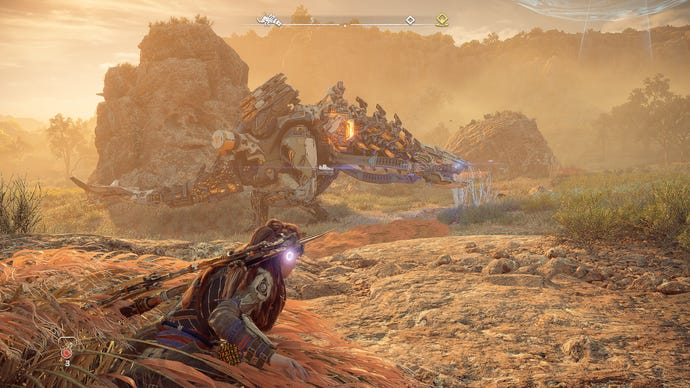
Horizon Forbidden West system necessities and PC efficiency
Earlier than entering into any check outcomes (for benchmarking, I had Aloy operating round a comparatively busy stretch of an early open world part), let’s remind ourselves of Forbidden West’s PC necessities:
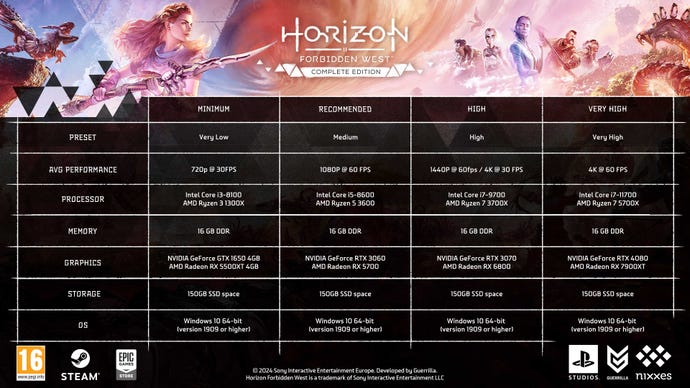
150GB is not any small storage ask, to make sure, although keep in mind that this PC model accommodates each the principle recreation and the substantial Burning Shores growth. In any other case, there’s nothing right here that ought to shock the senses, and I’d again up the advice of an SSD. Forbidden West shouldn’t drop useless on a tough drive, however you received’t get to take full benefit of its properly brisk, DirectStorage-assisted load speeds.
I didn’t have any of the precise minimal {hardware} handy, however you may be stunned by how far less-powerful elements can go. The common-or-garden GTX 1060, paired with our check rig’s standard Intel Core i5-11600K, averaged 40fps on native TAA with the Medium preset. FSR 2.2 on High quality mode acquired this as much as 50fps, and enabling Dynamic Decision Scaling (DRS) with a 60fps goal nudged it additional as much as 54fps.
DRS deserves a second to itself as, unusually, Horizon Forbidden West allows it by default; I needed to change it off for many benchmark runs. I often hate any type of dynamic decision settings as they have a tendency to provide very sudden, distracting rez drops to cope with dipping framerates, in what I’d contemplate a treatment being worse than the illness. Right here, although, it will probably work properly when paired with an upscaler like FSR or DLSS. The inner rendering decision nonetheless drops when issues get bushy, however these modifications are extra incremental and gradual, and since upscaling is in impact, the tip end result would possibly properly conceal there being any vital discount in any respect. It’s subsequently price making an attempt on low-end {hardware}, although be warned that it’s far much less helpful to extra tricked-out PCs. My RTX 3070 averaged 55fps at 1440p with DLSS on High quality, and including DRS with a 60fps goal solely acquired it as much as 56fps.
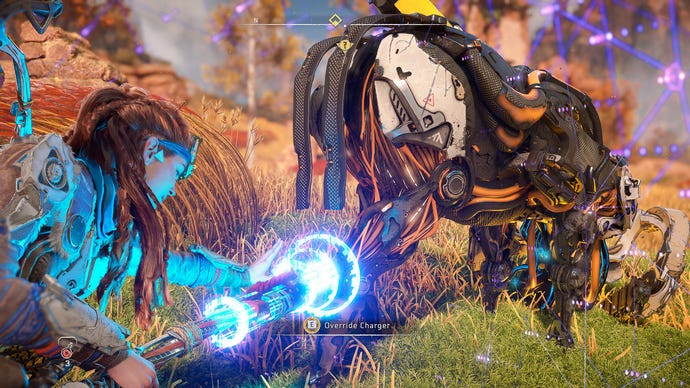
If quicker framerates are the purpose, I’d additionally recommend setting a a lot greater goal than what you truly need – supplied your display’s refresh fee permits it. On an MSI Skinny GF63 gaming laptop computer (with an RTX 4050, Intel Core i5-12450H, and 1080p show), the Low preset was pulling 48fps with DLSS High quality and DRS on 60. After upping DRS to 90, efficiency improved to 58fps – nowhere close to 90fps, clearly, however a lot nearer to the 60fps I wished.
Anyway, such methods aren’t at all times obligatory anyway. That RTX 4050-powered laptop computer may nonetheless get 46fps out of the Low preset utilizing upscaling-free DLAA, and again on desktop, the mid-range RTX 4060 may common 63fps at 1440p when operating Medium and High quality DLSS. At this GPU’s extra commonly-deployed decision of 1080p, it may run the Very Excessive preset at 48fps with native DLAA, rising to 57fps with DLSS on High quality. DLSS 3 body technology – an unique to RTX 40 collection homeowners, as there’s no FSR 3 help – may then drive all of it the way in which to 83fps.
Whereas Forbidden West’s lower-end compatibility is commendable, DLSS 3 exhibits it will probably profit from premium techniques too. At 1440p, the RTX 4070 Ti was already producing a slick 76fps with Very Excessive and High quality DLSS, however a single body gen toggle turned that into 103fps. And at 4K, it helped the flagship RTX 4090 flip a 76fps common (additionally on Very Excessive/High quality DLSS) into 109fps. All with out the slightest trace of picture technology errors, equivalent to distorted UI icons.
(Talking of 4K, you will get away with a lot much less graphics card than an RTX 4090, although it ought to nonetheless be one thing high-end. The RTX 4070 Ti can deal with it, averaging 59fps on Very Excessive with each High quality DLSS and body technology.)
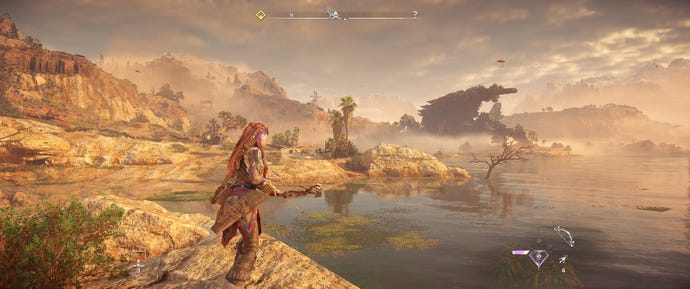
Many of the different PC perks (21:9 and 32:9 ultrawide help, 48:9 triple monitor help, full rebindability and so forth.) are competently fitted as properly. There’s no ray tracing, however truthfully, Forbidden West seems to be wonderful with out it.
Nonetheless, there are some hiccups that cease this being a real exemplar of the porting type. Nvidia Reflex, which cuts system latency however often leaves framerates alone, in some way hurts efficiency when in Increase mode – I may rise up to 10fps further on my RTX 4060 by simply switching from ‘On+Increase’ to ‘On.’ How bizarre, and fully in contrast to Reflex, which is in any other case so dependable that I’d often slap it on Increase mode as a matter after all.
And, whereas basic play is never interrupted by a stutter or sustained FPS drop, some real-time cutscenes present indicators of chug. I think it’s because Forbidden West makes use of them as alternatives to compile shaders, which I suppose is preferable to slowing down the actually-playable components, however nonetheless, it’s noticeable when it occurs.
Not that both of those are horrible points, a minimum of in my eyes. Boostless Nvidia Reflex continues to be sufficient to cope with the added lag that DLSS 3 imposes, so it’s going to be greater than sufficient for the (overwhelming majority of) PCs that don’t help Nvidia body gen within the first place. I’d nonetheless give Forbidden West’s PC port a very good invoice of well being, given it will probably run successfully on luxurious and price range {hardware} alike.
Even the dinky lil’ Steam Deck can take part. It requires deeper high quality cuts than those I’m about to recommend within the PC settings information, and I’m engaged on a separate, extra devoted take a look at it, however to this point it looks like the Medium preset will do about 30fps when paired with FSR 2.2 on High quality mode. The Very Low preset can also be viable at native 1280×800, although it loses numerous element that Medium preserves.
Horizon Forbidden West greatest settings information
In the event you’re not pleased with how the upper presets are performing, relaxation assured that Forbidden West is not any Dragon’s Dogma 2: the potential velocity enhancements, from rejigging particular person settings, are big.
Granted, so is the potential drop in visible high quality, and I’ve stated phrases to the impact of “this recreation seems to be good” too many occasions on this article to then recommend that you just whack half the checklist on Very Low. Nope, steadiness is greatest, so I took my RTX 4060 and tried reducing each particular person setting (from Very Excessive at 1080p) to see which may keep excessive and which of them are price sacrificing to the framerate gods.
Nvidia Reflex Low Latency: One thing ain’t proper right here, as the standard greatest setting for Reflex – On+Increase – appears to carry again total efficiency fairly a way. My RTX 4060 shot up from 49fps to 58fps simply by switching to On, with out the Increase, and I’ve seen enhancements on different GPUs too.
Dynamic Decision Scaling: Used with out upscaling, that is nearly a bog-standard dynamic rez instrument, and may thus be ignored. With upscaling, and a sufficiently excessive goal, it seems to be significantly better, and I discovered it will probably genuinely assist with lower-tier GPUs. Simply, not a lot the RTX 4060. In reality, setting the goal framerate too low can truly restrict efficiency of quicker PCs, because the upscaler dynamically switches to native rendering extra typically. With each DLSS on High quality and the DRS goal on 60, my check PC averaged the identical 49fps because it did with native TAA, however with DLSS alone it may handle 57fps.
Once more, DRS is sweet for much less {powerful} techniques that want further assist to remain above 30fps, however in any other case, upscaling is okay by itself.
Anti-aliasing: Wanna stick to completely native rendering? TAA is narrowly the quickest choice right here, with Nvidia DLAA dropping one body to 48fps. Don’t hassle with SMAA, which is each gradual (44fps) and rife with jaggies.
Upscale technique: Though Forbidden West isn’t a type of video games that wants upscaling to be midway playable, sticking to the very best High quality mode may be worthwhile even at 1080p. DLSS seems each the sharpest-looking and the quickest, averaging 57fps, whereas FSR 2.2 is a decent, extra platform-agnostic different with 55fps. Intel XeSS, which doesn’t have the readability of FSR 2.2 nor (with 54fps) the velocity, may be disregarded.
DLSS body technology: Flip this on in case your graphics card permits it. There aren’t any tangible drawbacks to Forbidden West’s body gen, and at native 1080p it acquired my RTX 4060 from 49fps to 79fps in a single click on. Mixed with DLSS on High quality, that turned 83fps.
Texture high quality: I didn’t see a efficiency enchancment from decreasing textures on the RTX 4060, so there’s a very good likelihood you may depart them cranked up. Nonetheless, I did get a extra pronounced enhance on the ol’ GTX 1060, so a discount might be acceptable on playing cards with low VRAM. Attempt Medium earlier than Low or Very Low, thoughts, because the latter two are a lot larger downgrades.
Texture filtering: Depart this up, as reducing it didn’t enhance efficiency for me in any respect.
Shadow high quality: One to chop, this. Switching from Very Excessive to Low acquired the RTX 4060 as much as 55fps, simply over a ten% enchancment, and the standard drop isn’t that unhealthy.
Display house shadows: Depart this up, as I acquired the identical 49fps regardless.
Ambient occlusion: Once more, this doesn’t appear to have an effect on efficiency both manner.
Display house reflections: You will get a bit of enhance by turning these off – an additional 2fps, in my case – although I’m unsure that’s price it for many GPUs. Low and Excessive carry out the identical as properly, so I’d attempt leaving reflections on Excessive.
Stage of element: One other unchanged 49fps end result when lowered to Medium, and something beneath that causes noticeable pop-in. I’d follow Very Excessive.
Hair high quality: There was one other 2fps available from dropping this to Low. Not a lot, however for minimal visible loss, I’d say take it. Sozzles, Aloy.
Crowd high quality: One other 49fps on Low, so depart on Excessive.
Terrain high quality: Additionally 49fps on Low, depart on Very Excessive.
Water high quality: Low raised common efficiency to 50fps, which is one other “it’s small however hey would possibly as properly” state of affairs.
Clouds high quality: 50fps from Low right here as properly, and the visible distinction is even much less noticeable than with water high quality.
Translucency high quality: Stick with Excessive res, the one different choice – Default – performs identically.
Parallax occlusion mapping: Loads of large phrases for one thing that doesn’t have an effect on efficiency both manner.
Subject of view: That is one thing you may tune to your tastes. Zooming out so far as potential lower my RTX 4060’s efficiency all the way down to 47fps, however that may simply be made up elsewhere.
Depth of area: On or off, it’s your name, as efficiency is unaffected.
Bloom: Disabling this gave me simply 1fps further, although that’s higher than nothing.
Movement blur energy: As with DoF, season to style. Movement blur doesn’t have an effect on efficiency a jot.
Sharpness: As that is only a postprocessing filter, efficiency is unaffected, although I see no cause to vary it from the default setting. Any decrease and the image loses definition, any greater and it seems to be overly processed.
Lens flares: One other 49fps, so you may maintain these on.
Vignette: Surprisingly, ditching the vignette border impact helped my check PC as much as 50fps.
Radial blur: No change right here, depart as is.
Chromatic aberration: One remaining nothingburger, performance-wise. Allow or disable as you like.
Ultimately, Forbidden West presents a great deal of settings on PC, however you solely want to vary a number of of them to quickly velocity up efficiency. Right here’s what I’d go for, on most GPUs and CPUs:
- Nvidia Reflex Low Latency: On (however not On+Increase)
- Shadow high quality: Low
- Hair high quality: Low
- Clouds high quality: Low
- Bloom: Off
- Movement blur energy: 0
- Vignette: Off
- Every thing else: Very Excessive preset equal
With TAA and native 1080p, these had my RTX 4060 averaging 78fps – visibly smoother than the Very Excessive preset’s 49fps, and nearly on par with Very Low’s 84fps. Besides, after all, it regarded a lot nearer to the previous, with maxed-out textures and ambient occlusion serving to to keep up Forbidden West’s pretty aesthetics.
Even at 1080p, although, upscaling is price a shot. High quality-level DLSS turned that 78fps into 96fps, and because the RTX 4060 helps DLSS 3, body technology may push all of it the way in which to 133fps.
In case your PC is nearer to minimal spec, attempt reducing texture high quality to Medium as properly. Display house reflections may also must go, although there’s a lot of shiny water in Forbidden West, so that you’ll really feel their loss extra keenly.