
UPDATE 23/6/22 6:10pm: We have now had the prospect to finish the set, operating the rule over the present technology console upgrades to Resident Evil 7 – the primary recreation to make use of Capcom’s wonderful RE Engine. Maybe inevitably, there’s an excessive amount of commonality between RE7 and the remakes, with the identical elementary upgrades in place. There are excessive frame-rate and ray tracing toggles, providing three totally different efficiency modes: 60fps with or with out RT in play, together with a 120Hz mode that solely works with ray tracing disabled.
There are decision upgrades, in fact, and identical to the Remakes, it is a case the place PS5 and Xbox Collection X run at 2160p utilizing picture reconstruction strategies to upscale from a decrease decision, whereas Collection S targets a extra conservative 1440p as a substitute utilizing the identical upscaling algorithm. The excellent news is that the RT mode appears to ship a locked 60fps on PS5 and Collection X, however efficiency continues to be beneath par on Collection S – although customers of VRR shows will likely be positive (the choice right here is just to disable RT, which locks you to 60fps). RT world illumination provides additional depth to the scene, however as you will see within the video under, RT reflections are a blended bag.
The 120Hz excessive frame-rate mode is nice throughout the board, nonetheless. The identical 2160p/1440p targets stay in place and all consoles do a fantastic job of delivering the requisite excessive efficiency. Certainly, PS5 and Collection X are primarily locked to the goal, and whereas Collection S can nonetheless drop to circa 100fps, it is nonetheless distinctive on a VRR show and never too unhealthy on a traditional show both. Finally, whereas the ray tracing might have been higher, RE7’s patch delivers – and it is a fantastic excuse to revisit a basic survival horror title.
ORIGINAL STORY: Within the wake its ‘E3’ press convention final week, Capcom left us with a fairly considerate present: current-gen upgrades for Resident Evil 2 Remake, Resident Evil 3 Remake and Resident Evil 7. In widespread with prior RE engine titles operating on PlayStation 5 and Xbox Collection consoles, the brand new options embody increased decision, ray tracing and 120Hz help. Stacked up in opposition to PS4 and Xbox One variations – and their enhanced equivalents – we’re a considerable suite of upgrades, however for the remake titles at the least, the brand new variations aren’t with out their minus factors.
Owing to the sheer quantity of take a look at instances right here, we have opted to separate up the protection. In spite of everything, even factoring out the PC upgrades (which we’re additionally masking a bit of additional on down the street), we’re nonetheless speaking about three video games with three totally different efficiency profiles – 27 totally different take a look at permutations. With that in thoughts, we have opted to focus on the Remakes first.
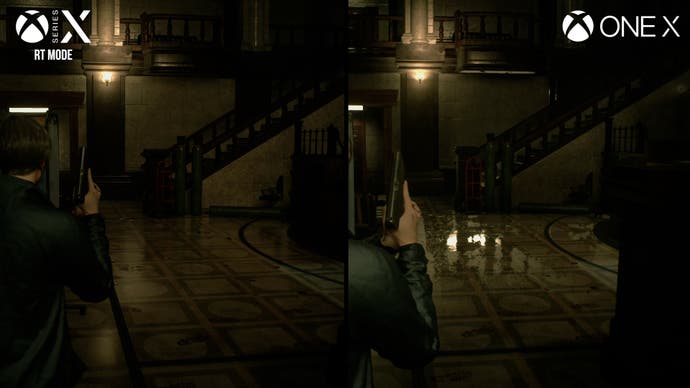
Of all the assorted modes on provide, it is the ray tracing improve we wished to try first as a result of in idea, it ought to eradicate one of the obvious visible points with the Remake titles – an unsightly rendition of screen-space reflections wholly at odds with what’s in any other case a top quality presentation throughout the board. The problem with SSR may be very easy: by their very nature, screen-space reflections can solely work the place there’s screen-space element to work with. In a third-person motion recreation like Resident Evil, the primary character on-screen occludes numerous the required element, resulting in some huge gaps within the reflections. That is compounded by low-quality reflections when the info is definitely there.
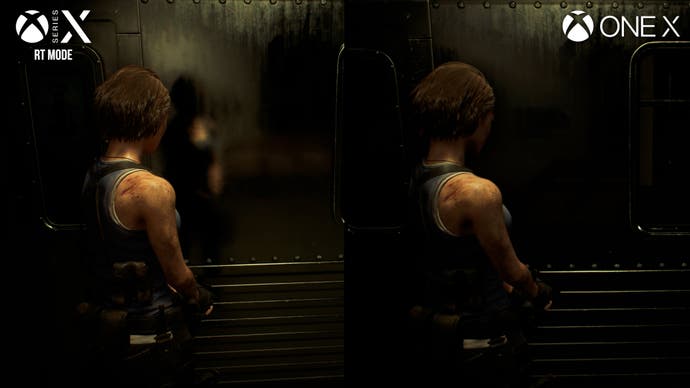
In widespread with prior RE titles, there are literally two RT results in play: reflections and world illumination. The reflections provide probably the most visually apparent enhancements: the entire occluded omissions are gone, whereas the low-quality reflections and their related ‘fizzle’ are additionally a factor of the previous. To be clear, identical to Resident Evil Village, the reflections are nonetheless pretty low decision, however it’s a giant enchancment regardless. The readability of the impact relies on the roughness of the underlying materials, with clean surfaces seeing the cleanest outcomes. Enemies are mirrored as properly, although alpha results understandably do not make the reduce. On the whole, the brand new RT reflections look refined however secure, although the selective software of RT reflections is disappointing – for instance, some mirrors do not provide correct reflections. Nonetheless, from what I’ve performed, Resident Evil 3 Remake appears to enhance the distribution of RT reflections in comparison with its predecessor.
Ray traced world illumination can be in impact, although the outcomes are typically on the refined aspect. A number of the smaller inaccuracies current within the unique launch are fastened, whereas some additional bounce lighting is seen in some scenes. That is positively an additive approach, fairly than a alternative for the prevailing baked GI, however the outcomes are cheap contemplating the constraints. The RT GI additionally appears to disable the ambient occlusion, with considerably blended outcomes. All informed, each RT options fail to supply a transformative enchancment to the Remakes’ visuals, however they do handle to deal with their most evident visible flaws whereas touching up some discontinuities in ambient lighting.
PlayStation 5 and each Xbox Collection consoles obtain the RT upgrades, with the extra highly effective machines focusing on what presents like a checkerboarded 2160p, whereas Collection S goals for a equally reconstructed 1440p – the decrease decision on the junior Xbox additionally leading to correspondingly decrease decision RT reflections. Nonetheless, all of the machines look suitably clear and clear, although the picture is a bit smooth owing to a heavy reliance on post-processing. Relative to the prevailing Xbox One X model, which ran at 1620p with reconstruction, picture high quality is certainly improved, although the variations are sometimes refined regardless of a reasonably large improve in decision on the brand new Collection X code. Advantageous element like hair is improved and distant textures resolve considerably extra clearly, however in typical play it does not appear far off.
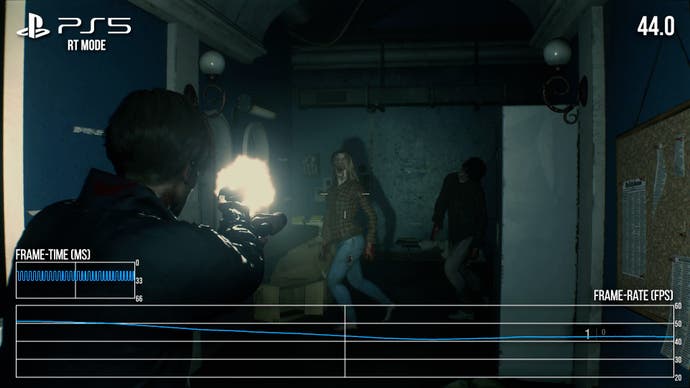
Efficiency is a blended bag relying on the mode chosen. Maybe not surprisingly, the RT mode is the heaviest on the {hardware}. The extra highly effective machines function largely in 40-60fps territory – a little bit of a frame-rate no-man’s land. Fixed judder and inconsistent enter are the outcome on a traditional show. Collection S suffers considerably extra and usually operates round 30-50fps, with a low of 26fps throughout one significantly demanding cutscene. VRR makes a distinction, however solely actually for Xbox Collection X the place the efficiency degree stays above the required 40fps degree (assuming your show helps 40Hz VRR). The opposite machines ‘ping pong’ out and in of the the VRR window, which is not a fantastic expertise.
So, on the one hand, I just like the RT help and the way it cleans up the visuals – however the quantity of customers who can successfully use that mode in a clean, pleasing means quantities to a minority of the viewers. The efficiency drop is disappointing, to be sincere. The same RT implementation surfaced in final yr’s Resident Evil Village, in any case, and that title largely caught to 60fps on PS5 and Collection X. Picture high quality is not far off the PS4 Professional or Xbox One X variations, however efficiency is definitely extra constant.
That leaves us with the excessive frame-rate mode from the sport’s choices, which once more delivers the identical reconstructed 4K/1440p decision with no RT, however removes the frame-rate cap, opening the door to efficiency as much as 120Hz for these with shows that supported the elevated refresh fee. There aren’t any different settings changes, which means that PS5 and Collection X each have a tendency to stay between 80-120fps, although they often hold round 100fps or so. Collection S is analogous, although it tends to backside out a contact decrease, with some readings within the 70fps space in intense moments. Between Collection X and PS5, the frame-rates are pretty comparable, although the Collection X tends to have a small efficiency benefit in matching footage – round 5fps – although it varies considerably.
The improved picture response and fluidity is definitely appreciated, however once more it is a mode finest fitted to use on VRR shows. As frame-rates improve, frame-time inconsistencies develop into much less outstanding and the notion of judder decreases, however I nonetheless discovered the unlocked framerate distracting on a non-VRR TV. VRR saves the day in fact and offers you a clean and stable-feeling output on an acceptable display. I do like the choice to play at 120Hz, however a extra secure lock to 120fps would have been appreciated – we’re unlikely to be CPU-limited given the efficiency of those titles on the last-gen enhanced machines, so some graphical settings tweaks might need been sufficient to provide a secure 120fps.
We’ll be Resident Evil 7 individually quickly and can replace this text accordingly, however within the right here and now, the upgrades to the Resident Evil 2 and three Remakes are welcome, however not fairly preferrred. There are respectable enhancements right here, with stable upgrades to graphical constancy and efficiency accessible throughout all three consoles – even the Xbox Collection S. The issue is that frame-rates are simply too inconsistent throughout two out of the three accessible modes, with each the ray tracing and excessive frame-rate modes sometimes failing to achieve their frame-rate targets. Most customers ought to actually keep on with the non-RT, non-high frame-rate profile right here, as it’s the solely solution to obtain secure efficiency.
In case you are a part of the minority of customers who has a show that’s able to VRR and 120Hz, you’ve extra choices. The 120Hz mode gives a sizeable improve in fluidity over the 60hz non-RT mode so long as VRR is enabled. Likewise, VRR helps salvage the RT modes to some extent, although solely the Collection X paired with a 40-60Hz VRR window feels secure sufficient to be price recommending.
However VRR must be a bonus, not a necessity. With some tweaks, extra secure frame-rates must be doable in these modes. Slicing decision could also be an excellent place to start out, because the video games’ darkish and low-contrast color scheme plus their heavy reliance on post-processing minimises the necessity to push numerous pixels. Because it stands, although, the RT and excessive body fee modes actually demand a variable refresh to look clean. And that is a disgrace, as a result of I feel these modes current some compelling options. The RT modes have specific attraction, as they handle to beat one of the apparent visible flaws with the unique releases, whereas bettering the complexity and consistency of ambient shading as properly. Resident Evil 3 significantly advantages, with its excessive density of reflective surfaces. Maybe these efficiency issues will be fastened in time. Till then, that is an intriguing improve – however you will want a sophisticated show to profit from it.