
Kullu, Himachal Pradesh: Nestled amid the picturesque panorama of the Himalayas, Malana village is well-known for a lot of causes, the first of which is the premium cannabis that’s produced right here, nicknamed ‘Malana Cream’. Additionally it is well-known for its indigenous democratic system and somewhat notorious for the way the natives understand outsiders — as ‘unclean’ and untouchable. The hamlet in Himachal Pradesh attracts round 15,000 to twenty,000 vacationers yearly throughout the peak season in April-June and September-October.
This mountain village is now grappling with a mounting rubbish disaster which is marring the pure magnificence. Piles of rubbish welcome you as you enter the village, and alongside the best way, the shiny wrappers of chips and goodies are littered till even the remotest components of the village.
Specialists say that the surging inflow of vacationers coupled with the village’s distinctive social and cultural practices have hindered efficient waste administration initiatives.
Based on Pradeep Sangwan, founding father of Therapeutic Himalayas – which carried out a clean-up drive within the village in 2019 — the social cloth of the village impeded their marketing campaign for the reason that locals of the world establish themselves as descendants of Aryans, higher caste and refused to take part. The village is overwhelmingly homogenous with solely 28 out of the 1,722 folks within the village figuring out as Schedule Caste, in accordance with the 2011 Census.
Sangwan tells of his expertise in different villages whereas conducting a cleanliness drive. “In different areas like Kaza city and Chitkul village, we all the time acquired sturdy assist from the native panchayat and the neighborhood — particularly from the youthful era and academic establishments. In lots of villages, residents themselves additionally volunteered to gather the trash,” he says.
That is in stark distinction to how the inhabitants reacted to the drive in Malana. “Residents weren’t prepared to wash their environment. We even obtained permission from the temple committee, however they refused to take part as a result of their excessive social standing. Some even stated that they had been prepared to pay as a lot as required however they might not take part in any cleanliness drive. This was very discouraging for the volunteers,” Sangwan tells 101Reporters, including that the organisation has not organised every other cleanliness drives within the village since then.
Conventional beliefs not aligned with fashionable waste administration strategies
“The villagers think about themselves particular and sacred, main them to imagine that they can’t totally combine with the overall inhabitants. The native customs dictate that outsiders can not contact Malanis, their temple or sacred platform,” explains Vijay Kumar (42), who plies his taxi between Jari to Malana village entry level.
“The folks of Malana imagine that collaborating in such communal efforts could doubtlessly expose them to people from decrease castes — and concern that this might incur the wrath of their deity Jamlu Devta. This concern, in flip, reinforces the apply of untouchability, additional segregating them from others and isolating the village from collaborating in broader initiatives aimed toward sustaining cleanliness and hygiene,” Vijay says.
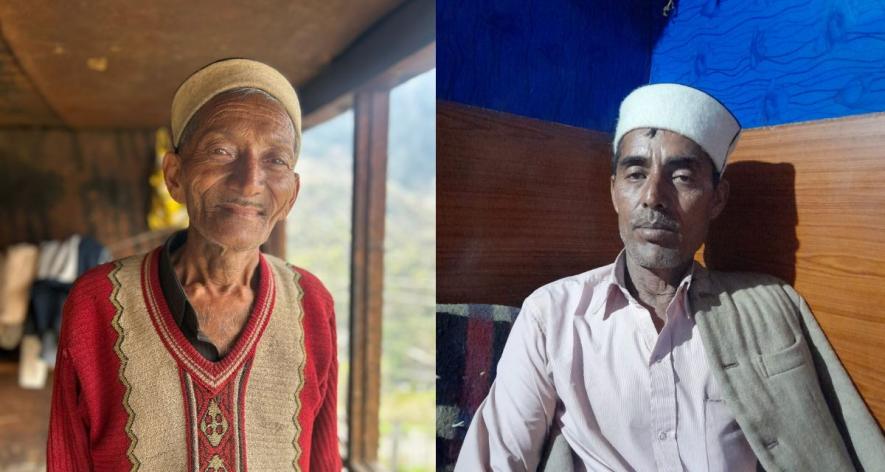
(Left) Swaru Thakur, a resident of Malana village; (Proper) Raju, the Pradhan of the village. (Photograph by Rachna Verma, 101Reporters)
Raju Thakur (55), the Malana sarpanch agrees that the “higher caste standing” of the residents makes them hesitant to select up rubbish. “If outsiders are usually not allowed to the touch us, how can we contact their rubbish?” he remarks. When requested about whether or not the panchayat has initiated any community-led cleanup drive previously, he evaded the query citing lack of funds as an excuse.
Swaru Thakur (82), one of many oldest residents of the village, blames “outsiders” for dirtying their environment, saying that the vacationers deliver their trash and dump it within the village space.
Miscommunication resulting in plastic pileup
Thakur’s assertion shouldn’t be with out advantage. A spot close to a water stream reducing throughout the village has a mound of plastic bottles, courtesy of the vacationers.
Based on Sharwan, a café proprietor, all of this is because of a misunderstanding. “The locals have a perception that water flowing via this stream is scared to Jamlu Devta. No outsider needs to be allowed to cross the stream with ‘exterior’ water, and due to this fact the vacationers are requested to empty their water bottles earlier than continuing additional. Nevertheless, as a result of a language barrier vacationers usually misread the villagers’ intention considering that they need to discard their bottles, which is resulting in a big buildup of plastic waste there,” he tells 101Reporters.
“The villagers maintain the assumption that any detrimental power or evil introduced by vacationers shall be washed away after they drink from the stream,” he provides.
No try has been made by the residents or panchayat to seek out a substitute for test the miscommunication.
Based on the sarpanch, typically the locals get collectively to rent a ragpicker from the Jari hamlet who collects among the plastic bottles within the space, whereas some are washed away within the river circulation. “A number of years in the past, dustbins had been put in alongside the tracks of the village by the officers from the Malana hydro undertaking. Nevertheless, quickly after a few of them had been stolen and others damaged,” he provides.
The villagers additionally say that their households don’t generate as a lot waste. “No matter little is generated is burnt in tandoors which might be current in each home. Typically kids litter the environment with chips, toffee wrappers,” the sarpanch says.
It is very important be aware that the apply of open burning of waste is dangerous to the setting and public well being, because it releases poisonous pollution and contributes to air air pollution. Many Indian cities and states have rules and pointers in place that prohibit or limit the burning of waste, together with kitchen waste, says Khwaish Gupta of Waste Warriors, an organisation that helps arrange waste administration methods within the Himalayan Area.
Gupta explains that over time as villages like these opened themselves little by little to outsiders the residents’ consumption patterns additionally modified. “They’re additionally consuming packaged items that are disposed of carelessly. The issues are the identical in different villages, which can be compounded by the distinctive social traditions of this village. But it surely stays that there’s a lack of understanding among the many locals and long-term interventions on the native degree,” she provides.
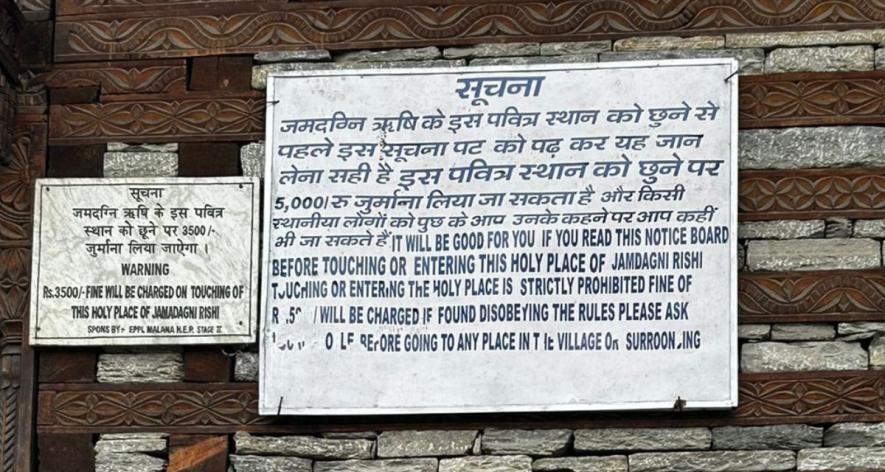
An indication indicating penalty for touching the temple. (Photograph by Rachna Verma, 101Reporters)
Additionally, apparently, the village has fines for a number of petty offences — like touching an individual, their spiritual areas and temples, their water our bodies or houses. The fines vary from Rs 500 to Rs 50,000, relying on the severity of the offence nonetheless, there is no such thing as a positive for littering.
Spilling out
The unsegregated stable waste shouldn’t be solely hampering the fantastic thing about the village but in addition plaguing its solely water supply. Many of the rubbish is dumped on the entrance of the village close to Malana Nala. “In sure areas, the river has utterly modified its circulation because of the rubbish heaps,” says the only ASHA employee of the village Nirmal Devi. No official research or testing has been executed concerning the contamination of water within the space.
The deputy commissioner of Kullu Ashutosh Garg expressed concern over the rubbish disaster within the Malana village. “The administration has tried quite a few clean-up drives with NGOs and faculty kids previously however acquired no assist from the village. Nobody got here ahead to take part.”
The official provides that there’s a glimmer of hope as among the youths of the village have began leaving to pursue increased training, signalling a gradual shift in mindset and potential progress in future.
Rachna Verma is a Himachal Pradesh-based freelance journalist and a member of 101Reporters, a pan-India community of grassroots reporters.